Well, as I mentioned in my previous blog, last week I received an email from Mike Jones, who is the CEO and founder of Nessy.com and he approved of my blog, suggesting that I use this platform to also share my understanding of the Science of Reading and Structured Literacy. Nessy and other dyslexic programmes already use these studies as the basis of their teaching for reading and spelling and it is now recommended this is the best way to teach all learners. This will probably be the longest blog I write (sorry!), but it does contain important, relevant information and eventually I will transfer this information onto a page on my site.
Although I am no expert, for the past couple of years I have been involved in intense study of teaching for the dyslexic student and programmes based on the Science of Reading. It has been recognised that if this research is helping dyslexic individuals, then it can help all students to strengthen their reading skills. The Science of Reading is not a fad, a new idea or a programme of instruction but is the result of many years of careful research which identifies the five essential components that make up the Simple View of Reading. Structured Literacy incorporates all five of these components i.e. phonemic awareness, phonics, fluency, vocabulary and comprehension. The structured, systematic way of teaching dyslexic individuals reading and spelling skills is now being used in mainstream schools as the best method for teaching all children. Today, I am going to try my best to share my views and explanations as to why programmes and teaching based on information from these scientific studies can inform effective instruction to benefit all students, including those who are dyslexic. …………..
From studies and research over many years, scientists together with reading experts have discovered how we learn to read, what skills are involved, how these skills work together and which parts of the brain are responsible for reading development. We are now able to understand how a child’s brain acquires and processes information and the cognitive processes that are essential for reading proficiency. This conclusive, supported research has resulted in an evidence-based, best practice approach for teaching basic literacy skills leading to Structured Literacy. Structured Literacy hinges on a well-developed, systematic and cumulative curriculum that directly teaches students phonology, sound-symbol association, syllables, morphology, syntax, and semantics in an explicit and diagnostic manner. Using a structured and explicit teaching approach is proven to be beneficial to all students, not just those with dyslexia or other reading difficulties.
Nowadays, it is against all the principles of teaching accurate reading skills to ask a child to look at the picture for clues if they can not read a word. The result of guessing a word only means that a child will start to guess more words instead of trying to decode them and therefore will not be reading accurately, which can cause many misunderstandings. A picture can help keep a child’s interest and can lead to more discussion, but should never be used when trying to read a word and a child should never be asked to ‘guess’ what a word says. This also means that a learner should never be asked to try and guess what a word may say by looking at the rest of the sentence for clues from the context or by using the first letter of a word. Instead, a child needs to be shown the strategies to be able to accurately decode unfamiliar words. If they are finding many words difficult to read in a book, then they need to find a book which is decodable according to the graphemes that they have learned in a structured, systematic programme as it is essential children are not guessing words. These decodable books should only be used for a short time as learners quickly strengthen their knowledge of grapheme/phoneme correspondence. However, books above their reading capabilities should still be shared and read to a child where required, as they will find huge benefit being exposed to a range of text, which will strengthen and widen their general knowledge and vocabulary. Increasing fluency requires a lot of practice and can be developed by reading aloud to an adult who can support the learner, quickly picking up any errors and demonstrating strategies to help develop fluency. Therefore, silent reading will not help to develop fluency for the child who has not yet learned this skill.
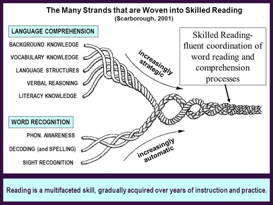
The Simple View of Reading (SVoR) has been validated by many scientists and demonstrates that reading comprehension is the product of of two main components i.e. decoding and language comprehension and this is further detailed in Scarborough’s Reading Rope. If either one of the components is weak, then reading comprehension is diminished, because no amount of skill in one area can compensate for lack of skill in the other. These two main features are made up of smaller strands, which gradually combine until a reader is skilled and able to display a fluent coordination of word reading and comprehension as shown in the diagram.
Structured literacy, based on the Science of Reading, uses a systematic and cumulative approach starting with the basic skills and building upon those learned skills. Direct teaching, using multisensory instruction, accommodates a range of learning styles and students should be constantly monitored as they learn to read, so any misconceptions can be quickly rectified. This way of teaching has been at the core of dyslexic programmes for many years and most dyslexic programmes are based on the Orton Gillingham method of teaching, which is an evidence based science of reading approach. What works for the dyslexic student works for all students.
Therefore, the skills that need to be taught to enable a child to be a confident, skilled reader are:
- Phonological awareness skills (see page on this site Phonological and Phonemic Awareness ) These skills need to be taught with the essential component of Phonemic Awareness. Phonemic awareness is recognising that words comprise of individual sounds that can be blended together to read or segmented for spelling. Learners should be taught how to mentally manipulate phonemes in spoken words.
- Phonics: (See page on this site First stages of reading and spelling) This is an explicit and systematic instruction in phoneme-grapheme correspondences to support both decoding and encoding. Phonics is the key component to reading because decoding is the foundation upon which all reading instruction is built upon. Children learn the grapheme-phoneme linkage and start to blend these letters together . Whole words are gradually logged into the visual memory store, so no longer need to be individually decoded and spellings can become more phonetically correct as learners find the correct grapheme for the phoneme. Phonics instruction also includes word analysis, syllabication, and morphology. Morphology concerns how words are formed through compounding, inflection and derivation. Morphological awareness instruction continues throughout school years and is an important part of embedding reading and spelling skills.
- Fluency: Gradually as the learner encounters more words and their skill develops with extended practice, they start reading these words automatically, quickly retrieving the phonemes stored in their memory. Once they achieve automaticity in word recognition, they no longer have to consciously think about each individual step in the process of reading and can do it without effort as these words and phonemes have been stored in their memory. When automaticity has been reached, the working memory is free for more complex skills such as comprehension. Fluency is formed by developing reading accuracy, reading rate and expression, which can be taught by supporting learners to develop typical speech patterns and appropriate intonations when reading aloud. This fluency of reading is now often referred to as ‘prosody’ ( which is a word new to my vocabulary, so I have attached a video below to explain this better than I could!).
Vocabulary is the body of words in a text or in spoken language. The understanding and use of a variety of vocabulary can be helped by the knowledge of orthography and morphology. Whereas etymology identifies the word origins, orthography identifies spelling pattterns within words, helping students to understand why words are spelled the way they are and the relationship between phonemes and graphemes to enable them to acquire the alphabetic principle. Morphology is the study of the word structure and their parts and with an understanding of morphology, learners are able to expand their vocabulary by adding morphemes such as prefixes and suffixes to root words.
COMPREHENSION – The purpose of reading is comprehension i.e. getting the meaning from the text. Without comprehension, reading is meaningless – just a list of words. Reading is a complex skill and students need to use a number of strategies to get the meaning from a text. Skilled readers can read quickly and accurately, whilst monitoring their comprehension as they read, using the many skills they have developed to be competent readers, including background knowledge, vocabulary and morphology. This view of reading is shown in the Scarborough Reading Rope (above), demonstrating that a skilled reader needs to be showing the fluent coordination of word reading and comprehension processes.
By understanding these stages and routes to reading, educators can identify where a learner is developmentally. Learners can then be given the appropriate support at the right time. which should impact greatly on their literacy development.
If you have read all the way down to here, WOW and thank you for spending this time with me! As you can probably tell, I am quite passionate about this subject and helping all children. I am pleased Mike Jones from Nessy took the time to read my blog and it has given me a boost to continue with these pages. I was happy to follow his suggestion and write in more detail about the Science of Reading and Structured Literacy, as I have been studying these approaches in detail for my dyslexia course. I find that the Science of Reading and Structured Literacy all make so much sense to me as an explicit, systematic, cumulative approach to help all learners. Therefore, I hope I have explained it properly, but if you wanted more details, there are many online papers that explain the research further.
Finally, just to let you know of some more freebies being offered this week from Nessy, but the dates are nearly running out so get in quick!
To Support children with dyslexia, Nessy are offering their Dyslexia Screener Dyslexia Quest for Free with the code TESTDQ. Visit the product page: British English: https://www.nessy.com/uk/product/dyslexia-screening/American English: https://www.nessy.com/us/product/dyslexia-screening/ This is a dyslexia screener so will identify those at risk for dyslexia by showing where their strengths and weaknesses are, it is not to be used to assess dyslexia. THIS EXPIRES ON 17TH OCTOBER!

Free Dyslexia Training for Teachers and Parents!

To celebrate Dyslexia Awareness Month, Nessy are giving away free licenses to their Understanding Dyslexia course, to help educators and parents learn more about dyslexia. Use the code: TEACHUD at the checkout at http://www.nessy.com. The code is valid for up to 3 free licenses per person. Schools interested in more licenses please contact: schools@nessy.com I definitely recommend this training, which only takes about an hour to complete, is really informative and usually costs £20 a person.
I think that is everything for this week. Do remember this is my interpretation of the Science of Reading and Structured Literacy based on my studies, but I do hope this has been helpful to someone else. If not, hopefully this blog will help towards my accreditation when it needs renewing and it does help me to keep all this information fresh in my mind! Have a good week. PJ
The most beautiful things in life are not things.
They’re people and places and memories and pictures.
They’re feelings and moments and smiles and laughter.
.
 Help your child learn to read, write and spell