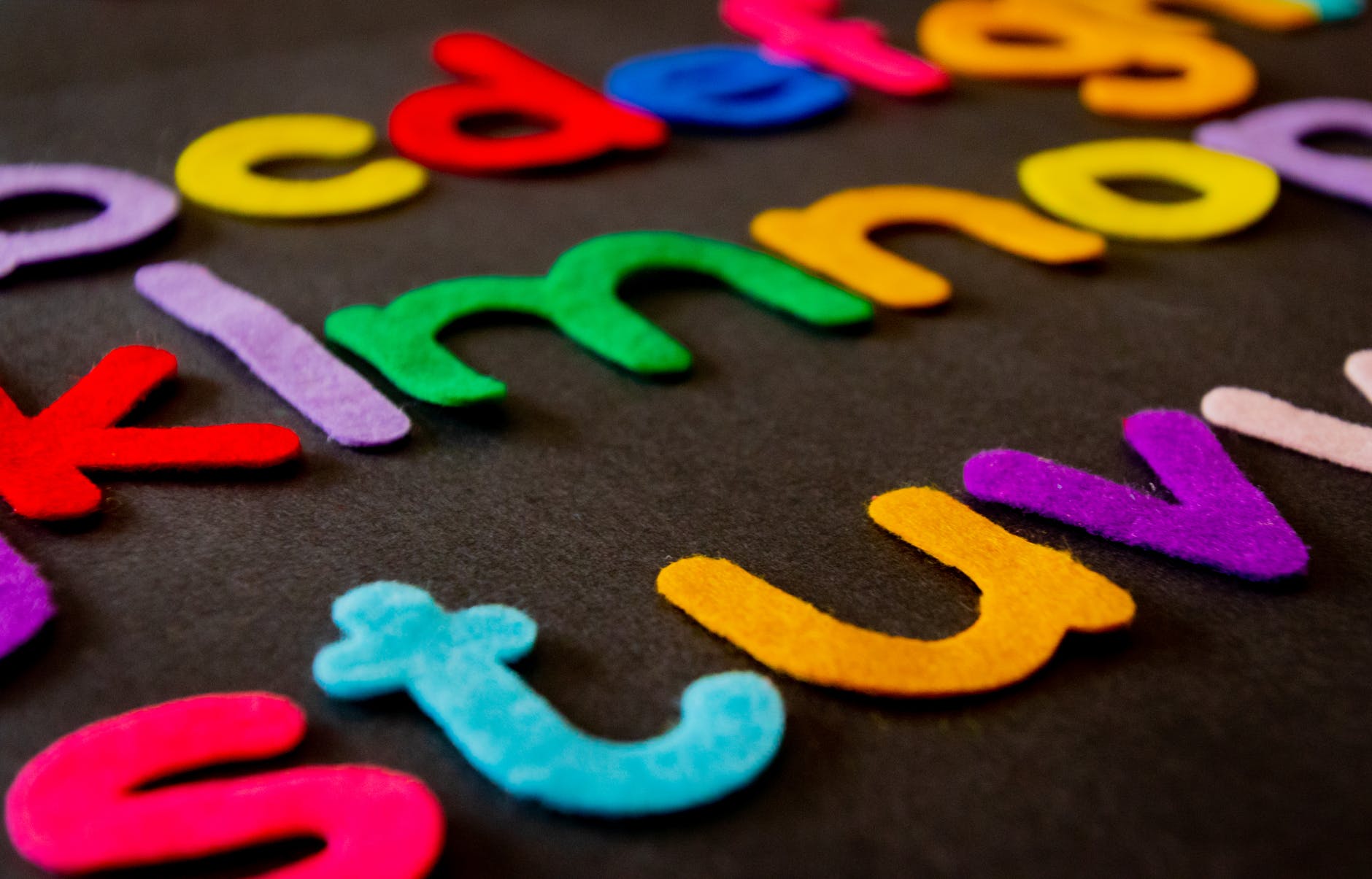
Vowels
Do you find that sometimes you are given information, but don’t question anything? For many years I just accepted the fact that the alphabet consisted of 26 letters, 5 of which are vowels and the rest are consonants. I never thought to question what is so special about those 5 letters that they are called vowels and I didn’t really know what was the difference between vowels and consonants, I just knew which category each letter was in. However, now I have learned why the vowels are different and I feel this extra information is useful for both the teacher and the student. Therefore, I want to try and explain – just in case you are like me and have never been told before why vowels are different to consonants.
In the English alphabet the five vowels are: a, e, i, o and u. The letter ‘y’ is usually classed as a consonant in the alphabet, but it is actually a semi-vowel, because although it makes a consonant sound in words such as ‘yes’ and ‘yell’, it can also make a vowel phoneme in words such as ‘funny’, ‘gym’ and ‘shy’. The vowels are special because when they are articulated nothing is obstructing the airflow and the mouth is open. All the vowels are also voiced sounds, so the vocal cords are used; we can check this by either feeling the vibration of the vocal cords on our neck as we say the sound or (and I prefer this method) we can try and alter the pitch of a sound and if we can do that, it is a voiced sound. There is at least one vowel in every syllable of a word. In fact, when we clap the syllables in a word, we are actually clapping and counting the vowel phonemes as we open our mouths to articulate them.
The vowels can make long, strong sounds as in pāper, hē, hūman, pīper or short, weak sounds as in căt, shĕd, trĭm, sŏck, ŭnder. It is important that learners understand which letters are vowels and can differentiate between the short, weak phoneme and the long, strong phoneme, because spelling rules often depend on this. Most phonics programmes refer to vowel phonemes as either ‘long’ or ‘short’ sounds. However, because I use the programme ‘Nessy’ for interventions and Nessy calls the vowel sounds ‘strong’ or ‘weak’ to explain the spelling rules easier, I now refer to the vowel sounds as either ‘long, strong’ or ‘short, weak’ to ensure the children have a good understanding and can apply the wording from Nessy as well as other phonics programmes.
Many intervention and phonic programmes will also encourage writing either a breve or macron symbol over the vowel when talking about the phoneme (sound). The breve can be written over the vowel to indicate if it is a short, weak vowel sound e.g. c/ /ă/ /t/ and the macron can be written over the long strong vowel sound e.g. /h/ /ē/. I find using these symbols very useful to demonstrate which phoneme I am talking about and children can go through words and use the symbol to indicate if the vowel is making a short weak or long strong vowel sound to strengthen their reading and spelling skills.
Syllables in words can be closed (ending with a consonant) or open (ending with a vowel phoneme). A vowel will usually make a short, weak sound in a closed syllable (when a vowel is followed by one or more consonants in a syllable) e.g. hĕn, păn/dĕm/ĭc. A vowel will usually make a long, strong sound in an open syllablle e.g. hē, hū/man, pā/per.
Have a look at the page on this site entitled Alphabet for more information about the definition of consonants and vowels. Also, take a look at the page Phonological and Phonemic Awareness page for more details about syllables.
Tricky words
Although tricky/common exception words have some ‘tricky’ parts to spell and read, they all have some typical grapheme/phoneme correspondence that has already been taught. Therefore, the learners need to ensure they are reading/spelling those parts of the word that they already know and only have the ‘tricky’ part to work out. However, what happens when you have a word such as ‘one’ which is difficult to demonstrate any phoneme/grapheme correspondence? This is when it is useful to look at the origins of a word and look at words which include the word ‘one’. The word ‘one’ was originally pronounced differently as demonstrated in the words ‘lonely’ , ‘only’ and ‘alone’. These words and their meanings are therefore best to be introduced along with the word ‘one’ to understand the spelling. The origins of words can be discovered on the website https://www.etymonline.com/ which is a really great website, as it is useful to look at the etymology as well as morphology of words to be an accurate reader and speller. Many older children (and adults!) find it fun to discover the origin of a word and find out how the word and its meaning has changed throughout history, which usually explains unusual spellings.
BARRINGTON STOKE PUBLISHERS
Barrington Stoke are having a free early evening online event for those who would like to meet the team and hear more about their books and using them in schools AND they have a special guest appearance from former teacher and superstar-writer Ross Montgomery! Register here: https://www.eventbrite.co.uk/…/barrington-stoke…

I don’t know about you, but I have found these dark days make it difficult getting up in a morning. However, I am reminded of a poem by Tomas Roberts aka Tomfoolery, whose poetry I really like. I have placed the youtube video below of his poem ‘The World Awaits’ for you to enjoy. Have a good week. PJ 🙂
 Help your child learn to read, write and spell