
I hope you all had a lovely Easter. These months are rushing past and I can’t believe it is May already. This week, I wanted to chat about phonics, training (both for the student and the professionals), touch typing and some zoom visits from Puffin authors.
It is useful to explain to individuals when to use ‘ou’ and when to use ‘ow’ in words to represent the /ou/ phoneme. Those of you who have read my recent blogs will recall I have mentioned how it is helpful for students to use the BME (Beginning, Middle and End) sheet for the best bet in spellings. Using the BME, the first choice in the beginning and middle of a word for the phoneme /ou/ is ‘ou’ and the best bet at the end of a word is ‘ow’. However, if a word ends with ‘l’, ‘n’, or ‘er’ then the digraph ‘ow’ is used in the beginning or middle instead. Therefore, we see cloud, pout, spout, but power, owl, trowel and clown. The phrase I use for the children is ‘The brown owl has a towel with a flower‘ with an picture to help them to remember this phrase and if the word rhymes with any of the words in bold, then they use the ‘ow’ instead of the ‘ou’. As usual, there are a few exceptions including the word ‘crowd’, but hopefully this information helps to make the correct spelling choice.
How do we know when to use ‘al’, ‘le’ or ‘el’ at the end of a word when they all sound the same? As a general rule, you use ‘al’ if you are adding a suffix onto a root word (e.g. magic – magical). Then, the most common ending is ‘le’ and I find this is usually used if the letter before it has a tall stick or tail e.g. little, candle, jingle, tickle. Finally, the letters ‘el’ tend to be used after a small, compact letter such as ‘m’, ‘n’, ‘r,’ ‘v’ and ‘w’ e.g. camel, tunnel, barrel, shovel, trowel. The Nessy video below highlights this last generalisation.
For those KS2 children who still find handwriting difficult and would benefit from using a computer, a touch typing programme is recommended, so they can learn to type at speed. There are various programmes which will help learners, including Nessy Fingers from £30 p.a. (more details on https://www.nessy.com/en-gb/product/nessy-fingers-home), the free BBC Dancemat for KS2 students on https://www.bbc.co.uk/bitesize/topics/zf2f9j6/articles/z3c6tfr or Typing Club on https://www.typingclub.com/sportal/program-3.game. If, however, students would like an online class, then see below for details of DITTAS Dyslexia Services on https://www.dyslexiaservices.net/group-tuition

PUFFIN AUTHORS ZOOMING INTO CLASSROOMS
On Friday mornings, authors and illustrators from Puffin books will again be beaming straight into classrooms across the country via Zoom. More details can be found on http://www.puffinschools.co.uk/VirtualVisits. Each FREE 45-minute webinar session will include a presentation giving your pupils a behind-the-scenes look at their books, characters, and creative process before setting an exciting activity for the class. Before the event, you can download their pre-event pack with everything needed for the Visits, and you can also check out the free chapter samples for each book in the event series. Below are details of the next author to visit.

DITTAS DYSLEXIA SERVICES
UK based company DITTAS Dyslexia Services offer assessments, tuition and support for students, parents and professionals. Find out more about their recommended services, information and training on the website https://www.dyslexiaservices.net/dyslexia-tuiton. Their training and individual tuition can be completed online so suitable for most individuals.
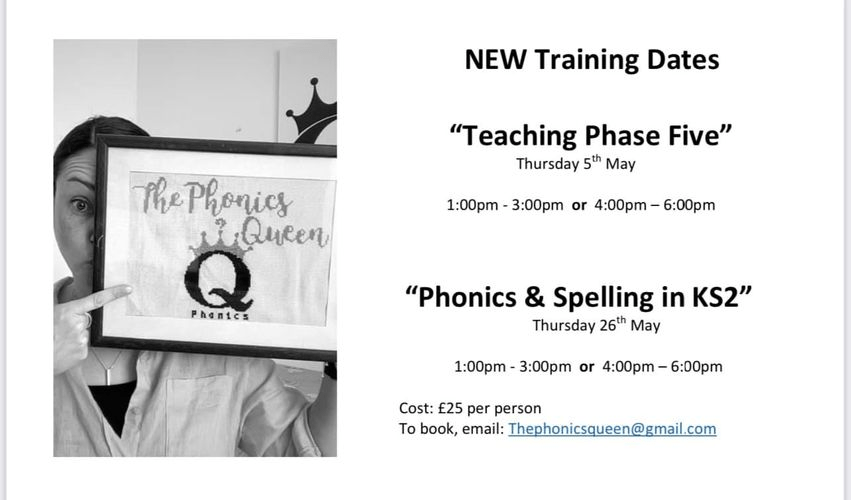
THE ‘PHONICS QUEEN’ TRAINING
Natasha Tuite, the Phonics Queen (follow her on the facebook group ‘Phonics Queen’) is offering some new training dates for phonics and spelling. Details below:
Have a good week. PJ 🙂

Kindness costs nothing, but means everything…..
 Help your child learn to read, write and spell