Just a quick update what is going on and what new resources and sites I have found this week for those who have difficulties with literacy or maths…..
Latest News for SPLD
Signs of dyslexia can be apparent from an early age and it is proven that the earlier a dyslexic individual has interventions put in place, the easier it will be for them to keep up with their peers. The longer effective intervention is delayed, the more accommodations and support will need to be put into place. Last week in the UK, MP Matt Hancock introduced the Dyslexia Screening Bill to the House of Commons. This Bill is proposed to ensure that all children are screened for dyslexia and have access to early support. Mr Hancock has now secured a second reading date of the 16th September, when there will be a full debate on the Bill. I am interested to see how this Bill progresses and how it is intended to be acted upon.
Dyscalculia Network
Dyscalculia is a recognised specific learning difficulty in maths. There are many resources and websites with more information online including http://www.dyscalculia.network.com, which is a specialist Dyscalculia Network in the UK, helping parents and teachers find support for those struggling with numeracy. The Dyscalculia Network has up-to-date information about dyscalculia and details how to find a specialist dyscalculia assessor or tutor in your area who can help you or your child. There are many resources on their site, including ‘Times Tables Tetris’ which can help learners understand and practise times tables. Click on the picture to be directed to this resource on the Dyscalculia Network site.
Times Tables Tetris!
Morph Mastery
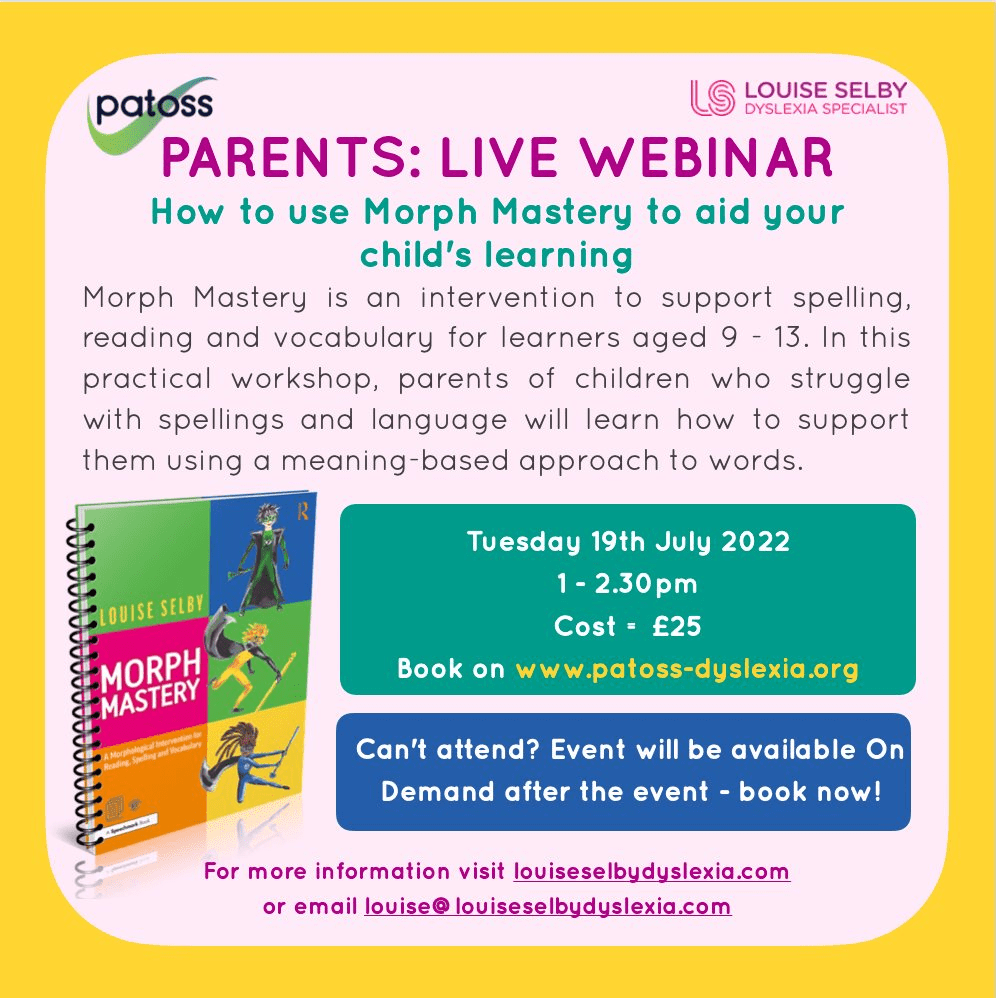
Morphology is often the overlooked building block for reading fluency, comprehension and spelling. It is the system of language by which words can be broken up into units of meaning i.e. morphemes. Morphemes can be root words, prefixes or suffixes. The root word is the purest meaning within a word once prefixes and suffixes have been removed, whilst prefixes and suffixes are not words in themselves, but units of meaning (morphemes) placed at the beginning or end of a word. Louise Selby has created an intervention called ‘Morph Mastery’ aimed at learners aged 9-13 and she is providing training for this programme on a PATOSS webinar for parents on 19th July, see details below.
Open and Closed Syllables
Finally, Mrs Siravo has released another fun video on You Tube to help explain the difference between open and closed syllables to learners. Knowing the difference between open and closed syllables helps a learner with reading and spelling words. This video reiterates that an open syllable ends with a long, strong vowel sound and a closed syllable ends with a consonant, which makes the vowel a short weak sound.
Signing off with some useful advice I saw this week ….
If you had £86,400 in your Bank acount and someone stole £10, would you be so upset you would throw the remaining £86,390 away? Of course not. You have 86,400 seconds in your day, why let someone’s 10 seconds of negativity take away your remaining 86,390?
LET GO – MOVE ON.
Have a good week. PJ 🙂

Strive for progress, not perfection.
Photo by Asad Photo Maldives on Pexels.com
 Help your child learn to read, write and spell