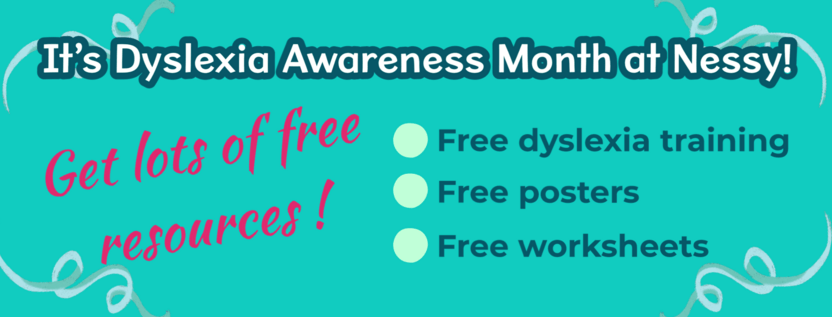
So, as October is coming to an end and Dyslexia Awareness month is nearly over, don’t forget to look on the Nessy website to sign up for their dyslexia training as it is still free for the next couple of days. Go to https://www.nessy.com/en-gb/free-resources/dyslexia-awareness-month. Nessy provide helpful training for parents as well as educators and schools can sign up for a number of licences so that all staff can be more dyslexia aware. I have signed up for the free training subscriptions so I can share this information with colleagues who want to know more, why don’t you too?
Dyspraxia

Research shows that 52% – 53% of children with dyslexia also have dyspraxia (Kaplan et al, 1998). Dyspraxia may affect reading, writing, coordination, balance and self-care. It is a lifelong condition and occurs across the full range of abilities. SEND Station are now offering new training to explain further and their first session is on 7th November. Go to http://www.sendstation.co.uk for more information or book for under £10 on Eventbrite.
Learned Helplessness
I was recently watching a video of an experiment demonstrating learned helplessness. It was really interesting and helped me undertand more why learners may sometimes be reluctant to attempt work given to them or give up quickly, even if a particular activity is suitable for their needs.
Several students were in a classroom, split into two groups and everyone was given 3 anagrams to solve independently. After each word, the teacher asked who had solved the puzzle. The first group had been given simple anagrams for the first two words, which they were able to solve easily, but the second group were given impossible letters to unscramble. As the first group easily worked out their words, the students in the second group became confused and deflated as they assumed they were struggling with the same anagram that everyone in the first group had quickly solved. By the time they tried to work out the final word, which was the same for everyone, only a few students in the second group were able to work it out, whereas all the students in the first group gave the correct answer.
This experiment demonstrated that after experiencing numerous failures, individuals may find that a vicious cycle is reinforced. Learners may start to fail solely because they think they will fail, which in turn will confirm their belief that they will fail and then they give up trying i.e. learned helplessness. So, if a student is often given work that is too difficult for them, they may gradually lose their confidence and self esteem and expect failure. They start to believe they are unable to change the situation and feel they won’t be able to do the work anyway so it isn’t worth them trying.
However, learned helplessness can gradually be unlearned by changing negative self talk into positive. Learners with difficulties will need work constantly differentiated to help avoid this vicous cycle of learned helplessness. Differentiation can be through modifying the content, presentation, environment, time or expectations of the teaching and learning. When a learner has achievable goals, their confidence and self esteem will usually increase and they will be more prepared to have a go and reach their full potential. I found the article I read really useful and I will certainly be more aware of ‘learned helplessness’ as I try to help strengthen a learner’s confidence and self esteem.
It is hard to believe, but my next blog will be in the half term leading up to Christmas! The time certainly flies. It will be a busy few weeks for most of us, trying to juggle so many things in our lives at home, at work and in life in general, but we will get there! Sending love and strength. Have a good few weeks. PJ 🙂

Don’t give up because of one bad chapter in your life,
Keep going as your story doesn’t end here.
Photo by Mayu on Pexels.com
 Help your child learn to read, write and spell