WORLD BOOK DAY 2.3.23

Photo by Pixabay on Pexels.com

Today was World Book Day in the UK – other countries celebrate this occasion on 23rd April.

World Book Day aims to change lives through the love of books, but for those with dyslexia reading can be daunting and a struggle. The campaign offers a wide range of free audiobooks for all ages to ensure every child has the opportunity to enjoy storytelling. Audio books can be a great way for everyone to access books and they are still underused as a resource. Visit: https://www.worldbookday.com/world-of-stories/ for free audio books

NESSY OFFER FOR WORLD BOOK DAY

Nessy is ideal if you are considering home educating, or if you just want to give your child’s reading and spelling skills a boost. Nessy programmes are based on the Science of Reading and can be really effective. Children enjoy learning with Nessy because it is game-based and learning is structured into small manageable steps.

HURRY!  Get 25% off Nessy Reading and Spelling, Hairy Reading and the Reading Journey Pack until 5th March.
Go to https://www.nessy.com/shop/home-products  and use the code: READING25 ­ ­ for 25% off! Offer ends 5th March.


Get 25% off the following Nessy programs:
Hairy Reading
For ages 4-6 A Structured Phonics Reading Program with Decodable Books.   Includes all the essentials necessary for foundational pre-reading and reading skills.
Nessy Reading and Spelling
For ages 6-11 Structured Literacy  for Reading  and Spelling.   An effective resource that covers  5 years of literacy development, with printable games and worksheets.
Nessy’s Reading Journey Pack
For ages 4-11 Help your child get their reading journey started off right.   This pack includes Nessy Reading and Spelling and Hairy Reading, to help your child get their reading journey started off right.
Hurry! Offer ends 5th March.

Revision and exam skills for secondary pupils with dyslexia

Some practical tips and techniques for pupils with dyslexia

By Dyslexia Scotland

When and where

Date and time

Wed, 8 March 2023, 19:00 – 20:30 GMT

Location

Online

About this event

  • 1 hour 30 minutes
  • Mobile eTicket

Join Skye and Lochalsh branch and Mary Evans, former support for learning teacher and Board member of Dyslexia Scotland, who will talk about revision and exam skills for secondary pupils with dyslexia.

Everyone is welcome to this online event on Zoom.

It will not be recorded. A Zoom link will be sent on the morning of the event.

All ages welcome but it is aimed at secondary pupils.

Book through Eventbrite.

Tribute to Sir Jim Rose

PATOSS paid tribute this week to Sir Jim Rose who recently passed away. ‘His ‘Independent Review of the Teaching of Early Reading (2006) led to the widespread introduction of phonics in the primary curriculum. His continuing work centred around the ‘simple view of reading’ stressing the two important dimensions of reading ‘word recognition’ and decoding has underpinned developing approaches to tackling reading. He was always sharing articles and research he found interesting, keeping his passion for developing reading very much to the fore. He was truly inspirational in his dedication.’

Carla Siravo Phonics Resources

Find lots of great free phonics resources from Carla Siravo on https://linktr.ee/carlasiravo?fbclid=IwAR0bpScMv4dF4KYUrJdfDZBaa3Exd0bmT4KpQ9Au0dXPEi3LqH3v5jUrBcY You may recognise Carla from some super phonic videos she has performed and I have shared on here previously. Look for her on You Tube for some fabulous catchy tunes all about phonics! Below is a fun video she made with her partner to explain how to decode words to read.

Have a good few weeks. PJ 🙂

I wandered lonely as a cloud, that floats on high o’er vale and hill

When all at once I saw a crowd, a host of golden daffodils…..

Pexels.com

Back at last! 13.2.23

Photo by Engin Akyurt on Pexels.com

Well, time certainly flies! Originally I was posting once a week, then once a month and yet somehow this is my first post of 2023. Welcome to those who have subscribed and liked pages over the past couple of months, it really is appreciated. It is lovely to see that these pages are having so many views from different countries and people are being directed to this site for spelling and reading support from search engines. I hope you have all managed to find some useful information on here and thank you for reading my blog.

Well, what have learners found tricky regarding spellings over the past couple of months? I have been asked to explain what is a good way to teach the spelling of ‘wh’ question words and especially how to help a learner differentiate between ‘where’ and ‘were’. I have found the best strategy is categorising all the one word question words together i.e. where, why, what, who and when, as all these begin with ‘wh’. Although the word ‘were’ can be part of a question, it does not make sense on its own as a question, so will not be part of the ‘wh’ spelling family. To aid visual memory, I tend to draw rugby posts and ‘birds’ sat on them, to symbolise the W and the H. (I have a feeling years ago I may have seen them taught as little bottoms sat on the rugby posts, but going with the times and the fact that the letter ‘w’ is now usually written with straight lines in handwriting schemes, I feel it is better to teach this as a bird perched on the rugby post instead!) The story is that the bird flies onto the rugby post with the bird representing the letter ‘W’ and the rugbypost represents the letter ‘H’ for the first 2 letters of each of the question words where, when, what, who, why. However, the bird has flown off the one rugby post which represents the one word question ‘how’ – with the phrase ‘How did that happen?’ This visual helps distinguish between the words who and how, which are sometimes muddled in spellings as well as separating the words ‘where’ and ‘were’. Using multisensory ways can really help unusual spellings to be retained in the longer term memory.

Unfortunately, I recently noticed that the link I posted on this site for the interactive alphabet arc does not seem to be working. I can’t seem to connect to it either, which is a real shame as this site has been so useful to help learners sequence the alphabet . I will try to find an alternative, but in the meantime, magnetic letters are always so useful for a learner to manipulate to help them with alphabet sequencing, reading and spelling

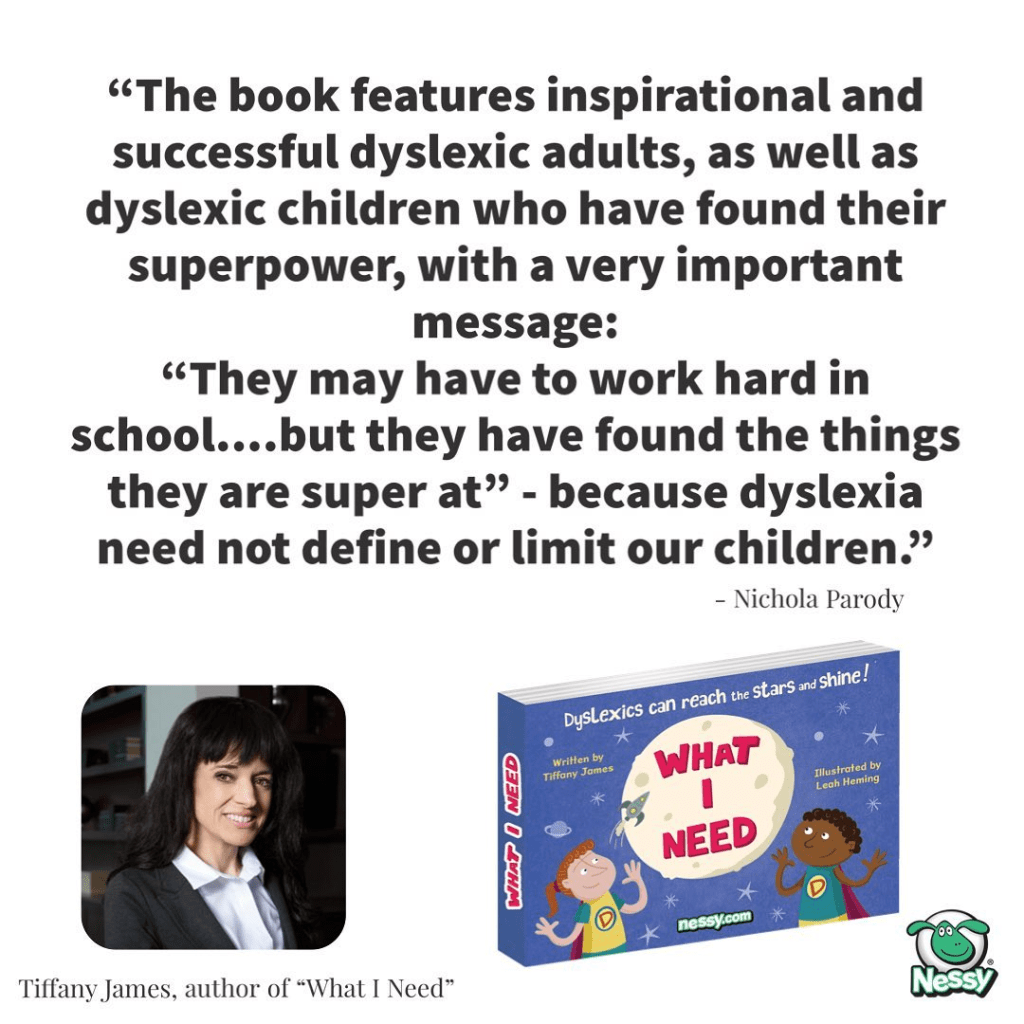
You may like to know that the really useful E books ‘What I Need’ and ‘Dyslexia Explained’ can be downloaded for free on https://www.nessy.com/en-us/free-resources.

Hopefully, once I get back into the routine of writing monthly updates again, there will another blog in March. I will start now gathering lots more information and news ready for next month! I have missed writing these posts, but sometimes there just never seems quite enough time for everything!

Have a great few weeks everyone! 🙂 PJ

Photo by Pixabay on Pexels.com

Nessy Offer and Phonics Vocabulary

For a limited time only, get 70% off Nessy Reading and Spelling! Offer ends 26th of November. Use the code: THANKSNESSY 

Get 40% off all other programs and packs, available to redeem until the 28th of November. Use the code: 40PREBF

Buy Nessy Reading and Spelling and get Hairy Reading for FREE. Offer ends 28th November. Requires 1 of each product in the basket to qualify.
Use the code: BUY1GET1

*Black Friday offer is for parents, caregivers, and homeschoolers. To view Nessy for Schools go here.

The American site for Nessy can be accessed on https://www.nessy.com/en-us and the same 70% offer is available in the UK on https://www.nessy.com/en-gb/shop/home-products

Nessy is ideal if you are considering home educating, or if you just want to give your child’s reading and spelling skills a boost. Nessy programmess are based on the Science of Reading, so you can be sure that they are effective. Children enjoy learning with Nessy because it is game-based and learning is structured into small manageable steps.

Phonics Vocabulary

Phonics has its very own vocabulary! At first, a lot of these words seem alien to most of us, but after using them daily, they just flow naturally. What is good is that this vocabulary can be used consistently in phonics sessions. Here are some terms that are regularly used.

BLEND – To combine individual phonemes that make up a word by merging them together in one continuous stream of sound to say the whole word e.g. blend the phonemes /sh/ /e/ /d/ together to say the word ‘shed’. For those learners who need more help with oral blending, then the arm can be used for multisensory support.

SEGMENT – To segment means to separate a word into its individual units of sound (phonemes). In order to spell a word, it first needs to be segmented e.g. chip would be /ch/ /i/ /p/. When segmenting, it is beneficial to use the multisensory learning of using the fingers to isolate and count the phonemes as shown in video below.

GRAPHEME – This is a letter or group of leters written down to represent a particular phoneme. The way graphemes are used to represent phonemes is known as the ‘alphabetic code’.

PHONEME – This is an individual sound in words, which is the smallest unit of sound in speech e.g. the word shop has 3 phonemes /sh/ /o/ /p/.

With one thing and another, I seem to be publishing these blogs once a month rather than once a week. With today being 24th November, in a month from today it will be Christmas Eve! You may or may not have wanted to hear that news…….However, I hope you all enjoy the rest of November and the run up to Christmas. Take care. PJ 🙂

27.10.22 Dyslexia, dyspraxia and Learned Helplessness

So, as October is coming to an end and Dyslexia Awareness month is nearly over, don’t forget to look on the Nessy website to sign up for their dyslexia training as it is still free for the next couple of days. Go to https://www.nessy.com/en-gb/free-resources/dyslexia-awareness-month. Nessy provide helpful training for parents as well as educators and schools can sign up for a number of licences so that all staff can be more dyslexia aware. I have signed up for the free training subscriptions so I can share this information with colleagues who want to know more, why don’t you too?

Dyspraxia

Research shows that 52% – 53% of children with dyslexia also have dyspraxia (Kaplan et al, 1998). Dyspraxia may affect reading, writing, coordination, balance and self-care. It is a lifelong condition and occurs across the full range of abilities. SEND Station are now offering new training to explain further and their first session is on 7th November. Go to http://www.sendstation.co.uk for more information or book for under £10 on Eventbrite.

Learned Helplessness

I was recently watching a video of an experiment demonstrating learned helplessness. It was really interesting and helped me undertand more why learners may sometimes be reluctant to attempt work given to them or give up quickly, even if a particular activity is suitable for their needs.

Several students were in a classroom, split into two groups and everyone was given 3 anagrams to solve independently. After each word, the teacher asked who had solved the puzzle. The first group had been given simple anagrams for the first two words, which they were able to solve easily, but the second group were given impossible letters to unscramble. As the first group easily worked out their words, the students in the second group became confused and deflated as they assumed they were struggling with the same anagram that everyone in the first group had quickly solved. By the time they tried to work out the final word, which was the same for everyone, only a few students in the second group were able to work it out, whereas all the students in the first group gave the correct answer.

This experiment demonstrated that after experiencing numerous failures, individuals may find that a vicious cycle is reinforced. Learners may start to fail solely because they think they will fail, which in turn will confirm their belief that they will fail and then they give up trying i.e. learned helplessness. So, if a student is often given work that is too difficult for them, they may gradually lose their confidence and self esteem and expect failure. They start to believe they are unable to change the situation and feel they won’t be able to do the work anyway so it isn’t worth them trying.

However, learned helplessness can gradually be unlearned by changing negative self talk into positive. Learners with difficulties will need work constantly differentiated to help avoid this vicous cycle of learned helplessness. Differentiation can be through modifying the content, presentation, environment, time or expectations of the teaching and learning. When a learner has achievable goals, their confidence and self esteem will usually increase and they will be more prepared to have a go and reach their full potential. I found the article I read really useful and I will certainly be more aware of ‘learned helplessness’ as I try to help strengthen a learner’s confidence and self esteem.

It is hard to believe, but my next blog will be in the half term leading up to Christmas! The time certainly flies. It will be a busy few weeks for most of us, trying to juggle so many things in our lives at home, at work and in life in general, but we will get there! Sending love and strength. Have a good few weeks. PJ 🙂

Don’t give up because of one bad chapter in your life,

Keep going as your story doesn’t end here.

Photo by Mayu on Pexels.com

7.10.22 Dyslexia Awareness Week

Photo by Ivan Bertolazzi on Pexels.com

3 – 9 October is Dyslexia Awareness Week. So what has been happening?

Autumn is well underway in the UK and poet John Keats described it perfectly in his ode ‘To Autumn’ from the opening line ‘Season of mist and mellow fruitfulness, close bosom friend of the maturing sun’. Every autumn, many countries join in Dyslexia Week aiming to raise awareness of dyslexia. Special resources are produced and information readily available to share with teachers, employers and the general public to highlight a different dyslexia-related theme.

British Dyslexia Association

This year during Dyslexia Awareness week, the British Dyslexia Association is ‘reflecting on the barriers that those living with dyslexia often face, while also focusing on how individuals, organisations and the education system have continued to succeed and break through these obstacles.’ On their webpage, the BDA have links to interviews with celebrities who explain how dyslexia has affected their lives. Go to https://www.bdadyslexia.org.uk/support-us/awareness-events/dyslexia-awareness-week/dyslexia-awareness-week-2022 as Dragon’s Den entrepeneur Theo Paphitis and British Bake Off’s Lizzie Acker share their experiences.

One of my favourite videos to explain dyslexia to children is ‘See Dyslexia Differently’, by the British Dyslexia Association.

Nessy FREE Resources

The educational site Nessy is promoting Dyslexia Awareness throughout the month of October with lots of special offers on their site. Nessy is offering any teacher, anywhere in the world, FREE dyslexia awareness training. Earn the Level 1 Dyslexia Awareness certificate, plus the Level 2 Structured Literacy Awareness certificate at no cost during the month of October. Parents can also go onto this course by choosing the parent’s edition. Go to the page https://www.nessy.com/en-gb/free-resources/dyslexia-awareness-month where Nessy are offering more free resources, including their useful ebook ‘Dyslexia Explained’, which is written by the founder of Nessy, Mike Jones.

Twinkl

Twinkl Educational Publishing have lots of great educational resources and have added special articles for Dyslexia Awareness Week. The SEN Digest and the Parent’s Digest sections are full of really useful information.

Made by Dyslexia

Made by Dyslexia’ is a global charity, led by successful dyslexics.  They have built the world’s largest community of dyslexic people and their allies.  Their purpose is to help the world to understand, value and support dyslexia. In this next video their founder, Karen Griggs, gives her defininition of dyslexia and displays a thought provoking performance poem.

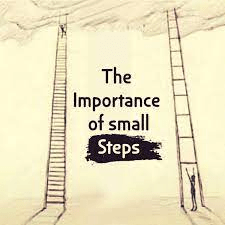
I love the following image, which has appeared a lot on social media recently. It has such an important message to remind us that small, achievable steps in learning can show great progress and help build a child’s self esteem and confidence. Many challenges may seem too overwhelming until broken down into these smaller, attainable stages.

Have a lovely week! PJ 🙂

Autumn is the season

that teaches us that change

can be beautiful.

Pexels.com

21.9.22 Nessy Offers and Spelling tips

Photo by Tima Miroshnichenko on Pe

Parents

It’s not to late to celebrate the Science of Reading this September, Nessy.com have been offering lots of free educational resources, including a free phonics app every week throughout September. Go to https://www.nessy.com/en-us/the-science-of-reading/science-of-reading-september for more details. There are also lots of free educational resources on their site throughout the year.

Last day for this app, so apply today!

Educators

SEND Station offer lots of affordable training and support for educators. I have attended various sessions led by the very knowledgeable professionals experienced in SEN. Go to https://www.sendstation.co.uk/ for a calendar of events.

Syllables and Spelling

There are various strategies and helpful hints to try and make reading and spelling easier. CLOVER is an acronym to help remind us of the main syllable types, which can help learners when reading and spelling words. These different syllable types are taught at various stages in a structured, systematic literacy programme. Look at the Spelling page on this site to find out what those letters stand for and an explanation of the syllable types.

Don’t forget though, there are a lot of words in the English language that do not follow the general spelling rules, often because they have originated from different languages. Www.etymonline.com is a great resource to discover the origin of words, which will often explain the spelling. Phonics, morphology and etymology need to be learned together to help with reading and spelling, especially for the older learner.

WWW.phonicbooks.co (or PhonicsBooks.com) publish some great phonic books, including some interesting ones for catch up readers. They also offer some useful information and resources on their facebook page and on the news section on their website. I especially liked their recent resource on facebook showing typical letter and sound confusion. Similar looking letters can easily be confused, but so can similar sounding phonemes, especially the voiced and unvoiced sounds such at /t/ and /d/ which are formed by the mouth in the same way, but the /t/ is unvoiced and the /d/ is voiced. Speech and language plays such an important part of learning to read and spell.

Take care and have a good week. 🙂 PJ

Through each week’s challenges, remember, you are enough!

We can only try our best throughout life.

22.8.22 Phonics, Spelling Rules and Specialist Teaching

Photo by Pixabay on Pexels.com

So, here in the UK we are coming towards the end of the lovely long summer holidays and we are starting to think about getting back to school. Therefore, today I thought I ought to start writing my blog again and include some interesting videos to gently remind us how important it is that everyone in a school setting has a good knowledge of phonics to help learners of all ages. Phonics, used alongside other multisensory learning is required for learners to become strong, confident readers and spellers. These skills are continually built upon throughout our lives.

Phonics

So, the big question is ‘Why is Phonics so Important?’ Natasha Tuite (aka The Phonics Queen) explains this in more detail in her new video, (aimed at school staff, but relevant to all) on her youtube channel.

Interactive Letter Tiles

Just before the holidays, I started using Edshed’s interactive letter tiles for spelling practice. This is available FREE on https://www.edshed.com/en-gb/lettertiles?fbclid=IwAR0bKWzBu8JL2I49e0VzZ55Po8K_MAGNbBZWnAajRuq7_XrX7mMHIdlok2Q These are great for learners to practise manipulating the letters to make words, as well as other phonics activities and can be especially useful for online tutoring.

Spelling Rules

Nessy do some great Spelling Rule videos on their Youtube channel, but some older learners may prefer the fun phonics videos on Mrs Silvera’s youtube channel, where spelling rules are sang to the music of familiar songs. I have referred to these videos before and there are some already on my Spelling Rules page. Here is the video for the Rule ‘c or k at the beginning of a word’. This rule is explained in more detail on the Spelling Rule page of my site under ‘Rule 3’.

Finally, I am happy to say that I have now received my teaching practice certificate from PATOSS (the Professional Association of Teachers of Students with Specific Learning Difficulties) to go alongside my Level 5 certificate from the British Dyslexia Association as a Specialist in Dyslexia for literacy support and intervention. Therefore, PATOSS officially advise that ‘it is recognised that I am a current specialist teacher with relevant practical experience, committed to maintaining best practice and ongoing development of my professional teaching skills’. That should stop me having imposter syndrome! Yes, I am definitely committed in trying my best to help learners reach their full potential! The research never ends and there are always new strategies to discover. There is never enough time in the day to read through all the information that is available, but I will try and see what I can find and then share the highlights with you all on here.

Have a lovely week, wherever you are and whatever you are doing. 🙂 PJ

Don’t count the days, but make the days count.

20.6.2022 Dyscalculia, Morph Mastery and Syllables

Photo by Magda Ehlers on Pexels.com

Just a quick update what is going on and what new resources and sites I have found this week for those who have difficulties with literacy or maths…..

Latest News for SPLD

Signs of dyslexia can be apparent from an early age and it is proven that the earlier a dyslexic individual has interventions put in place, the easier it will be for them to keep up with their peers. The longer effective intervention is delayed, the more accommodations and support will need to be put into place. Last week in the UK, MP Matt Hancock introduced the Dyslexia Screening Bill to the House of Commons. This Bill is proposed to ensure that all children are screened for dyslexia and have access to early support. Mr Hancock has now secured a second reading date of the 16th September, when there will be a full debate on the Bill. I am interested to see how this Bill progresses and how it is intended to be acted upon.

Dyscalculia Network

Dyscalculia is a recognised specific learning difficulty in maths.  There are many resources and websites with more information online including http://www.dyscalculia.network.com, which is a specialist Dyscalculia Network in the UK, helping parents and teachers find support for those struggling with numeracy. The Dyscalculia Network has up-to-date information about dyscalculia and details how to find a specialist dyscalculia assessor or tutor in your area who can help you or your child. There are many resources on their site, including ‘Times Tables Tetris’ which can help learners understand and practise times tables. Click on the picture to be directed to this resource on the Dyscalculia Network site.

Times Tables Tetris!

Morph Mastery

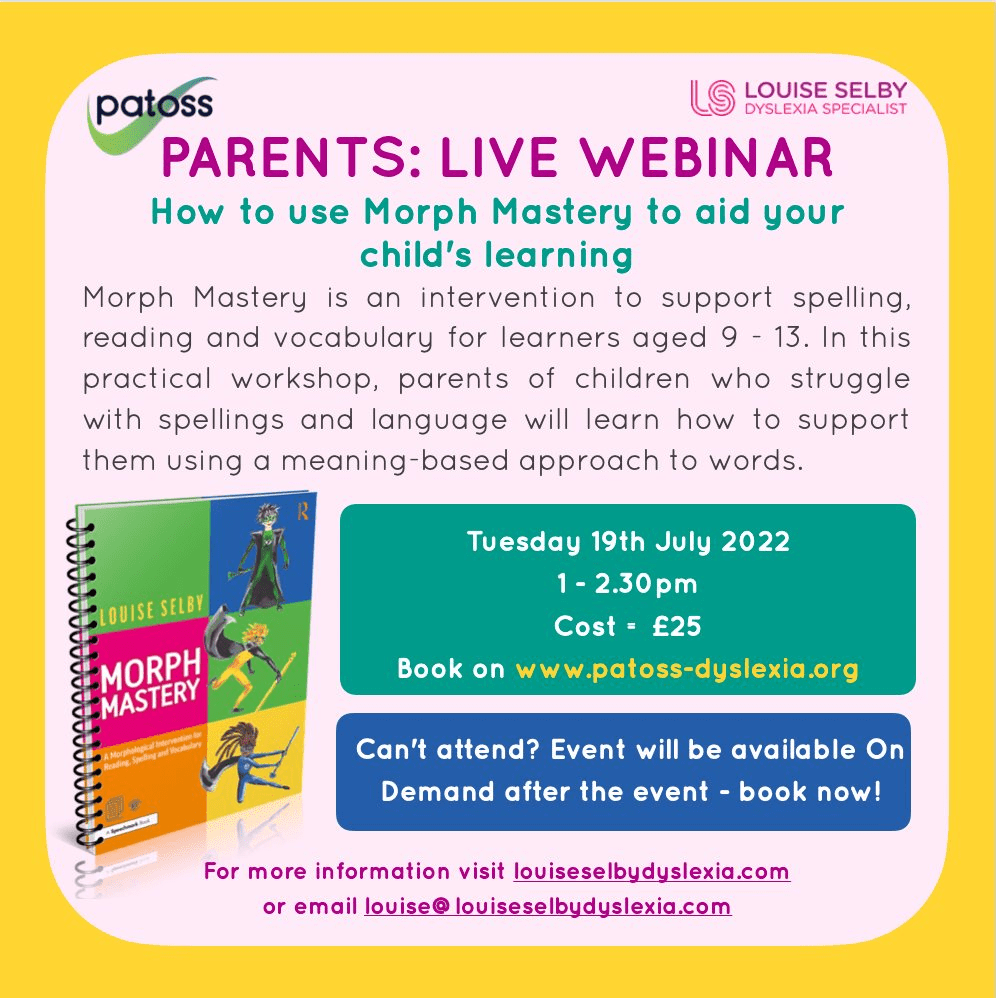
Morphology is often the overlooked building block for reading fluency, comprehension and spelling. It is the system of language by which words can be broken up into units of meaning i.e. morphemes. Morphemes can be root words, prefixes or suffixes. The root word is the purest meaning within a word once prefixes and suffixes have been removed, whilst prefixes and suffixes are not words in themselves, but units of meaning (morphemes) placed at the beginning or end of a word. Louise Selby has created an intervention called ‘Morph Mastery’ aimed at learners aged 9-13 and she is providing training for this programme on a PATOSS webinar for parents on 19th July, see details below.

Open and Closed Syllables

Finally, Mrs Siravo has released another fun video on You Tube to help explain the difference between open and closed syllables to learners. Knowing the difference between open and closed syllables helps a learner with reading and spelling words. This video reiterates that an open syllable ends with a long, strong vowel sound and a closed syllable ends with a consonant, which makes the vowel a short weak sound.

Signing off with some useful advice I saw this week ….

If you had £86,400 in your Bank acount and someone stole £10, would you be so upset you would throw the remaining £86,390 away? Of course not. You have 86,400 seconds in your day, why let someone’s 10 seconds of negativity take away your remaining 86,390?

LET GO – MOVE ON.

Have a good week. PJ 🙂

Strive for progress, not perfection.

Photo by Asad Photo Maldives on Pexels.com

12.6.22 SEND Station and Spelling Rules

Photo by Dale Brooks on Pexels.com

It has been a busy first week back after the half term break! This week I have been teaching the spelling of words containing the syllable /-le. The more I look into the different syllable divisions, the easier it is to teach and easier for learners to work out the spellings. I was asked recently if I taught all the syllable divisions for spellings and I hadn’t really thought about it, but actually I do now teach each of these explicitly. (More details of syllable division for spelling on the ‘Spelling Rules’ page on this site.) It is only the last couple of years I had realised that the final syllable of a word which contains ‘le’ always has another consonant attached to the ‘le’. It does make it so much easier for the learner to work out how to spell the word once they learn these generalisations. If the first syllable has a long, strong vowel it is split after the long vowel so it is an open syllable e.g. ca/ble, but if the first syllable has a short weak vowel then this syllable is closed in by the consonant e.g. mud/dle, and the second syllable always ends with a consonant before the ‘le’.

A funny moment earlier this week , when I used Google to search for some more ideas introducing a spelling rule. I was linked to a website, which looked really interesting. It was only when I clicked on the link that I realised that it had taken me to this, my very own site!! It does explain how there are now more visitors directed to this site through search engines. I hope I am able to give some answers and help for what people are looking for. I am thinking in the near future I will also make some more documents that can be downloaded from this website to assist with lessons. It will also then serve as my own file of resources. However, that may be more of a summer holiday type of project!

SEND STATION

I have mentioned SEND Station a few times previously, as they have a passion to help children who experience difficulties in their learning. I have really enjoyed their training sessions in the past and they are very knowledgeable in their fields. SEND Station is a collaboration between successful education providers who are experienced in providing on-line SEND training and support for schools and parents. They provide practical, easily accessible, great value support for neuro-diverse children and training for those who work with and support them. You can follow them on their facebook page or go to their webpage http://www.sendstation.co.uk for more information.

This week, SEND Station announced that the literacy intervention they have put together, named ‘Literacy Junction’ has been commisioned by five local authorities in South Wales. They are getting ready to ‘train the trainer’ so each of the schools involved will have a practitioner trained in delivering the intervention. More details will be forthcoming to ensure this training will be available to all. If any school in an English speaking country does not already have a trained dyslexia specialist or an effective literacy intervention set up, ‘Literacy Junction’ sounds as if it will be really useful to help the struggling learner. When I hear more, I will let you know on this blog.

Finally, with exams and tests abundant at the moment. I will just leave you with this well known quote.

‘Everybody is a genius. But if you judge a fish by its ability to climb a tree, it will live its whole life believing that it is stupid. ‘

Have a good week. 🙂 PJ

Keep chasing your dreams……

Photo by Samuel Theo Manat Silitonga on Pexels.com

28.5.22 Reading – Decoding and Syllables

Photo by Andrea Piacquadio on Pexels.com

“If a child memorizes ten words, the child can read only ten words, but if the child learns the sounds of ten letters, the child will be able to read 350 three-sound words, 4,320 four-sound words, and 21,650 five-sound words.” (Kozloff, 2002). This is why learning to decode words is so much better than trying to learn words by sight. Eventually the words that have been decoded will be ingrained in the memory and so a learner will have automatic recall of these words, making them almost like sight words. The difference is that the learner who has been used to decoding words will be able to approach any new word and use the strategies to read it correctly, whereas the learner who has only learned words from sight will find it difficult to read new words or words which have different affixes. Their strategy may be to just guess these words rather than try to decode them which could greatly affect their comprehension of texts.

Welcome to the many new followers of my blog this week. It has been fascinating to see how many different countries this blog has reached and I notice quite a few of you have joined us from America. Thank you everyone, it is lovely to see how many people now receive the updates. I hope you find this blog and site interesting and helpful – any constructive feedback is really welcome and let me know what else you would like to see on this site by sending a message on the contacts page.

The Science of Reading is becoming more widely known and the research understood in many countries, so educators are changing how they teach children to read and write based on this approach. Nessy.com provides lots of literature for many countries, to help teach children to read and write following the Orton Gillingham approach, which all dyslexic programmes are based on. Here is a video from Nessy, made specifically for an American audience about the Science of Reading, but it is relevant to all countries in teaching children to read English.

Nessy youtube channel

English is one of the trickiest languages to master reading and spelling. There are phonetic combinations that make up the sounds of words, but when the same letters are individually pronounced they do not sound the same. There are so many graphemes that have alternative phonemes and different graphemes that can represent the same phoneme – no wonder there is confusion!

There are various strategies and helpful hints to try and make reading and spelling easier. CLOVER is an acronym to help remind us of the main syllable types, which can help learners when reading and spelling words. These different syllable types are taught at various stages in a structured, systematic literacy programme.

C – closed syllable – means that the vowel in the syllable is followed by at least one consonant, therefore keeping the vowel sound short and weak i.e. hăt, crŭnch, ăd/mĭt. (See Rule 4 on Spelling Rule page.)

L – a consonant followed by ‘le’. Note that the consonant stays attached to the ‘le’ in the syllable. This syllable type is usually working alongside another syllable type and example words include bub/ble and ca/ble. (See Rule 13 on Spelling Rule page.)

O – open syllable ending with a single vowel making a long, strong sound e.g. hē, pā/per. (See Rule 4 on Spelling Rule page.)

V – Vowel teams can work together to make one sound e.g. train, spoon. The two letters make one sound and are collectively called a digraph.

E – split digraph where the ‘e’ gives the vowel extra strength to make its long, strong sound but doesn’t make a sound itself e.g. pipe, state.

R – ‘r’ controlled vowel. The ‘r’ follows a vowel and changes its sound e.g. shirt, start, curl, born, dinner.

Finally, UK schools are now enjoying half term and will be celebrating the Queen’s platinum jubilee during this week. Children in state funded primary schools across the United Kingdom should be receiving a memento of the platinum jubilee in the form of a book entitled ‘Queen Elizabeth: A Platinum Jubilee Celebration’. This book takes children on a journey through Her Majesty The Queen’s life, with chapters on her family and friends, achievements, work with charities, Jubilee celebrations and finally on Commonwealth innovations that have changed the world over the last century. Published by DK, it tells a story of a young girl, Isabella, visiting her Great Granny Joyce, who tells her about The Queen and this year’s Jubilee. This special celebratory book will also be available to buy from many bookshops and online retailers.

  • Fun facts:
  • Queen Elizabeth II was born in the same year as David Attenborough, Mel Brooks and the late Marilyn Monroe.
  • She is the longest serving monarch in the UK and amongst the top three longest reigning in the world.
  • Elizabeth II acceded to the throne at the age of 25 upon the death of her father,  George VI, on 6 February 1952 and her coronation took place on 2 June 1953 at Westminster Abbey, London.
  • She is the only person in the UK who is allowed to drive without a licence and does not need a passport.
  • The Queen has 2 birthdays, her actual birthday is on 21st April, but her official birthday celebrations are usually held on the second Saturday in June each year. This tradition was started by King George II whose birthday was in November. He wanted a birthday when the weather was warmer and he could have outdoor celebrations so he made an official day to celebrate his birthday in the summer to coincide with the annual military parade known as Trooping of the Colour.

Have a lovely week, whatever you are up to. Remember, if you see someone without a smile, give them yours. PJ 🙂

Photo by Porapak Apichodilok on Pexels.com