Although tricky/common exception words have some ‘tricky’ parts to spell and read, they all have some typical grapheme/phoneme correspondence that has already been taught. Therefore, the learners need to ensure they are reading/spelling those parts of the word that they already know and only have the ‘tricky’ part to work out.
Don’t be afraid to tell the learner that the word contains a rule they have not yet been taught, so is ‘tricky’ for the moment but will become clearer later. For example, some of the first ‘tricky’ words a child may encounter are ‘he’ and ‘me’. You can advise the learner that the vowel is making a long, strong sound and explain that the ‘e’ is a vowel and it has more than one phoneme (sound). It essential that children learn about the importance of vowels in reading and spelling right from the start. Show them words from the same family e.g. she, be, we and so they can make the connection with these words, but explain they will be taught these rules in detail later and for the moment they just need to know this ‘tricky’ bit of the word off by heart as explained below.
Once you have explained the word and identified the ‘tricky’ bits, then there are various ways to teach the children how to read and spell these words. All children (especially dyslexic individuals) will benefit from multisensory learning as this will help them to remember the words easier. I have come across a great way of teaching the tricky parts of these words i.e. the part that needs to be learned ‘off by heart’ because it does not have the usual grapheme/phoneme correspondence.
For example the word ‘said’ would be shown first as s❤d when you write only the graphemes which have the usual gpc, and the ‘ai’ grapheme would be represented by a heart because it needs to be learned by heart in this word (due to the fact it is making the /e/ phoneme instead of the usual long vowel sound /ā/). Similarly ‘was’ would be shown first w❤❤ because the letters ‘a’ and ‘s’ are not making their first choice phoneme, so you need to learn ‘by heart’ the spelling of the two phonemes /o/ and /z/ which are in fact unusually represented by the letters ‘a’ and ‘s’. This will make more sense when you watch the video below, I promise 😊 ……..
Some activities for learning to read exception words
New exception words can be introduced to a learner and the ‘tricky’ bit talked about so the learner starts to be able to decode part of the word and understand that the ‘tricky’ bit is not the usual grapheme/phoneme correspondence. These new words can then be placed on large individual cards as well as two other known exception words. Five smaller cards are made of each word and the learner has to match up the small card to the large word card and say the word as it is matched up. Then the learner sees how quickly they can read the words in a random order without the target cards.
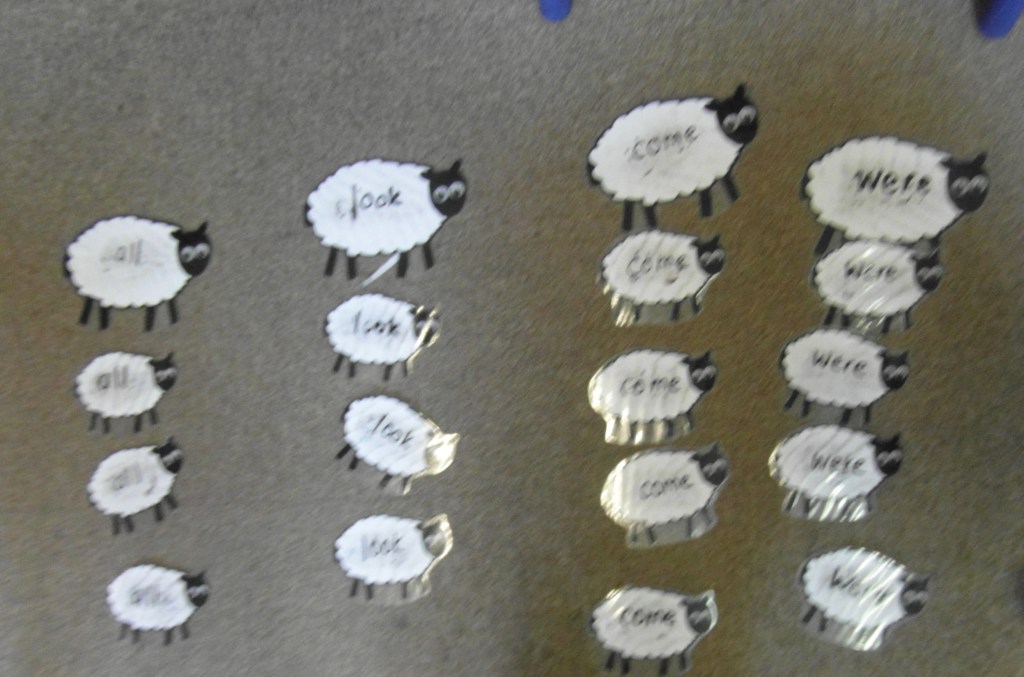
After teaching new tricky words, the learner can practise reading these amongst other words at speed on a precision teaching probe sheet. I have found the website http://www.johnandgwyn.co.uk. useful to create these sheets in the past and sendstation.co.uk arrange regular training sessions for precision teaching at a small cost.
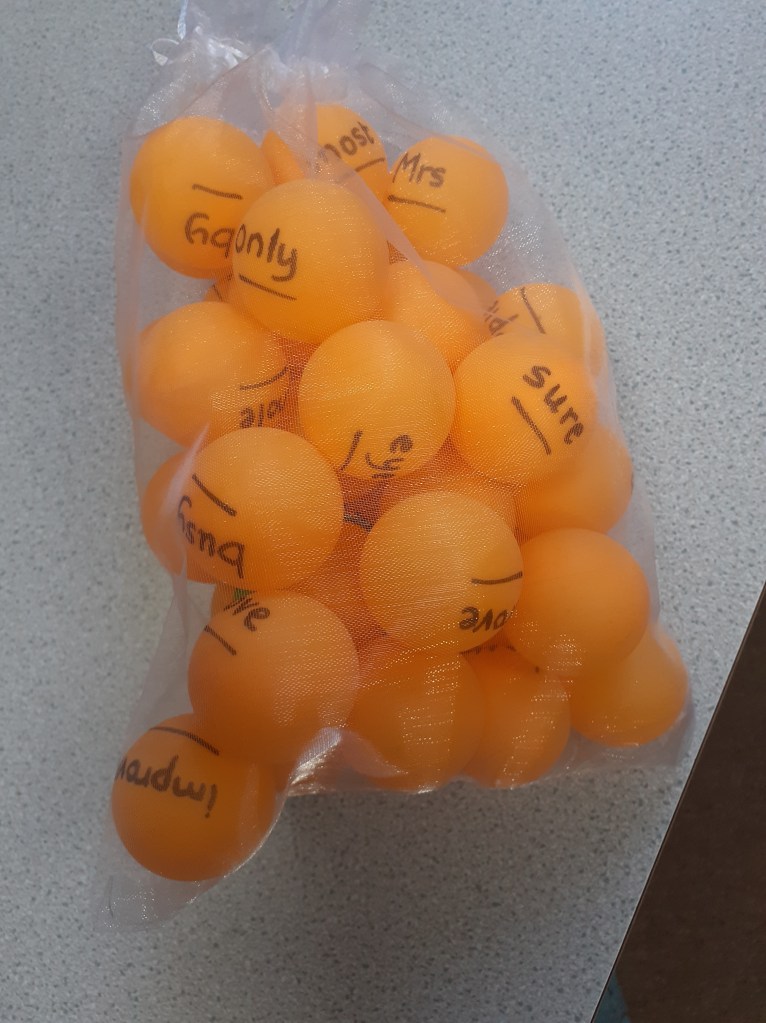
Multisensory games – At the moment the children I work with are enjoying having the common exception words written on ping pong balls. They catch the ball, read the word and if they are correct they can throw it into a box, but if they are wrong, the word is read out to them, pointing out which bits can be sounded out and which bits are the tricky bit, for them to repeat it and it goes back in the bag for another go later. This same game can be played for spelling the words, but an opponent reads the word and it gets thrown back to the learner to keep if they spell the word correctly.
Matching pairs (known as pelmanism) is a fun way to practise reading the common exception words. Write some new words and words already learned onto pieces of card so there are two of each word. Place them face down onto the table and each player turns over two cards. The player has to read the two words and if they match they are able to keep the two cards, but if they don’t match then the cards are returned face down. The winner is the player who has the most cards at the end. This also acts a good memory game. I have also seen this game played on a board with the words written on small circles and the words then covered over with large counters – the same rules applied whereby the player had to turn over two counters, read the words and try to match them, keeping the counters if they matched.
Learning Tricky Words Mr and Mrs
When explaining how to read and spell the words Mr and Mrs, I refer the students to days gone by, when the lady of the house was called the Mistress. I write the word ‘Mistress’ on the board and then begin rubbing out letters until only the M r and s are left showing. I explain that the word Mistress was a long word to have to keep writing out, so it was abbreviated to the three letters Mrs and over time the pronounciation was changed from Mistress to ‘Missus’ to refer to a married lady and is followed by the lady’s surname. The same applies to the word Mr as it used to represent the word ‘Master’ to apply to the Master of the house. Therefore I write the word ‘Master’ on the board and remove all the letters except the M and r. I explain that eventually it was abbreviated to ‘Mr’ and gradually it was changed to be pronounced as ‘Mister’. I add that because these words are always part of somebody’s name, they always begin with a capital letter.
Activities for spelling exception words
REMEMBER there is nearly always some usual phoneme/grapheme correspondence in ‘tricky’ words. Only part of the word is usually ‘tricky’ and it is only the tricky part that needs to be learned off by heart.
When trying to spell a tricky word, you could say the word as it sounds to help remember the spelling e.g. say the word ‘was’ as the letters usually sound to help with the spelling. However, explain that is not how we say the word ‘was’ in normal conversation, but it helps when spelling because it is one of the ‘tricky’ words’.
Use lots of different resources for multisensory learning. Practise spelling the word in paint, chalks, in sand, in shaving foam etc.
Use wooden or magnetic letters to spell words or make the letters using playdough to help the child use all their senses to aid the learning as this strengthens the neural pathways to the brain.
Make a model from playdough into an image associated with the word and then form the letters for the word as this will help make a visual connection.
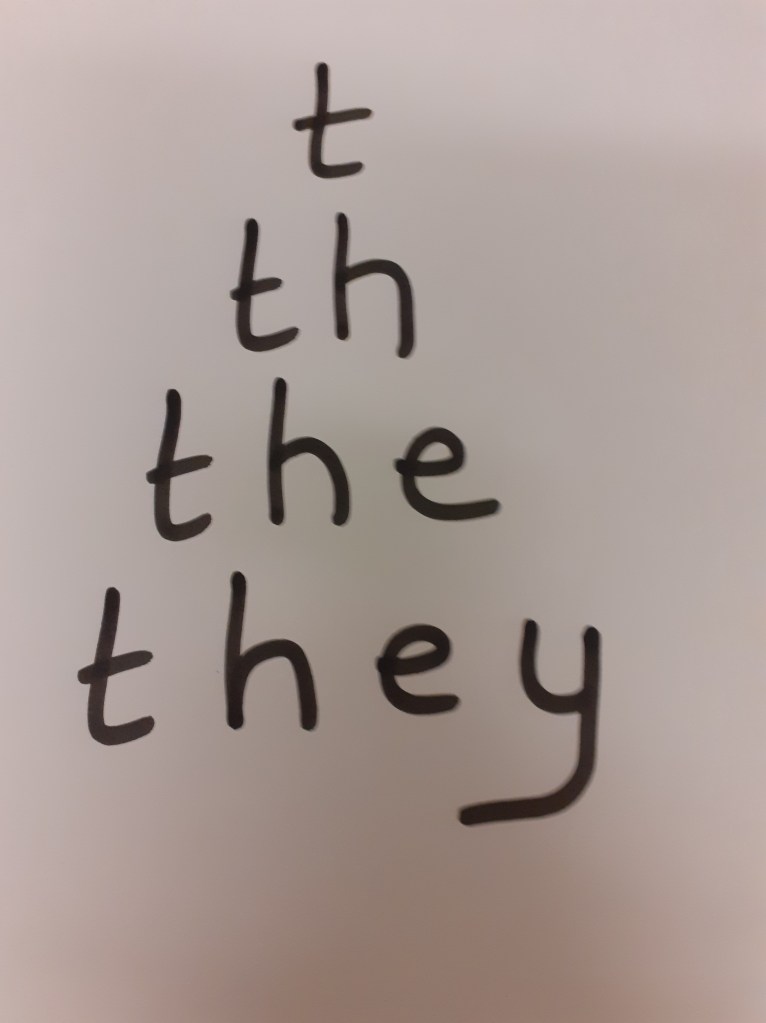
Pyramids – Practise whttps://youtu.be/EDFyg9StNTQriting the word with the first letter at the top of a pyramid, then adding one more letter each line until the word is written at the bottom of the pyramid or write the word out so that there are missing letters for the learner to complete.
Play a game called ‘Spelling Sparkle’ with a group of children stood in a circle. Teach the children the new word, then each child says a letter of the word until the word is completed. The next child says ‘Spelling Sparkle’ and the child after them has to sit down. Continue until there is only one child left standing. REMEMEMBER TO USE LETTER NAMES, NOT THE PHONEMES WHEN SPELLING THESE WORDS.
Mnemonics – e.g. ‘big elephants can add up sums easily’ to spell the word ‘because’. There are various mnemonics that are already made up for tricky words and children can have a go making up their own. (Although this helps a lot of children, I have found some dyslexic individuals find limited success with this method as they find the workload on their memory too much trying to remember the mnemonic.)
Have phrases to help with the tricky bit e.g. ‘I am a friend to the end‘ to remember to place the letter ‘i’ before ‘end’ to spell ‘friend’.
Use pictures to help a learner remember how to spell the tricky bit of a word for example the illustration below gives clues how to spell the homophones they’re (they are), their (belonging to them) and there (referring to a place).

Make pictures out of words. Find the tricky bit of the word and draw a picture around the letters to help remember the letters as shown on this Nessy video.
Look for words inside others e.g. notice the word ‘hen’ inside ‘when’ and ‘hat’ in the word ‘what’. Draw pictures of a hen next to the word ‘when’ and write ‘when hen’. Similarly draw a hat next to the word what and write ‘What hat?’.
Make connections to other words e.g. the words ‘there’ and ‘where’ contain the word ‘here’ .
The words to, too and two all sound the same and are therefore homophones, but they are spelt differently and have different meanings. How can learners work out the spelling for each word? There are several ways to ensure the correct spelling is used each time. The regular part of each of the words is the letter ‘t’ for the sound /t/. Therefore individuals should not be asking how they spell the whole word, as they will already know the first letter. What they may be asking is how to spell the phoneme /oo/ in each word. Strategies to learn to spell the /oo/ in these words include:
to – This is a short word which only needs two letters, meaning ‘going in the direction of somewhere’. Use sentences and actions to explain the meaning ‘Go to the shops’, ‘Go to the door’ etc. This word can be learned together with the word ‘do’ as the letter ‘o’ is making the same sound in each of these two letter words. Learners could remember a sentence ‘Do go to the ……’ and let them finish the sentence how they will remember best. They will soon realise that the words ‘do’ and ‘to’ end with the single letter ‘o’ when writing this sentence and can compare it to the different sound the ‘o’ makes in the word ‘go’.
too – This means excessively or also. A strategy can be used such as in the Nessy video below, when the monster eats too many cookies and each cookie represents the letter ‘o’ to help the learner remember the spelling and meaning of this word. For the meaning of also, a learner can remember that as it means ‘also’ so it ‘also needs another letter o’. Remind the learner that they can sound out all of this word phonetically /t/ /oo/.
two – meaning the number 2. The letter ‘w’ is included in this word, but cannot be heard. Children may like to make a picture or collage of ‘two wobbly oranges’ and write the initial letters of the words to write the word ‘two’ or they can make up their own mnemonic. Multisensory learning helps stengthen the neural pathways so the student can memorise these irregular spellings easier. However, if the child also learns the connection with the words twice, twins, twelve, twenty which are all to do with the number 2 (but unlike these words, the ‘w’ in the word two is no longer heard,) then this will add to the strategies used to remember the spelling for the word two. This is explained more in the second video below.
Question words where, why, where, who, why
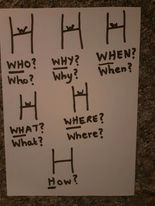
This is a good way to teach the spelling of ‘wh’ question words and especially how to help a learner differentiate between ‘where’ and ‘were’. I have found it is easier to categorise all the one word question words together i.e. where, why, what, who and when, as all these begin with a ‘wh’. Although the word ‘were’ can be part of a question, it does not make sense on its own as a question, so will not be part of the ‘wh’ spelling family. To aid visual memory, I tend to draw rugby posts and ‘birds’ sat on them, to symbolise the ‘W’ and the ‘H’. (I have a feeling years ago I may have seen them drawn as little bottoms sat on the rugby posts, but going with the times and the fact that the letter ‘w’ is usually written with straight lines in handwriting schemes, I feel it is better to teach this as a bird perched on the rugby post instead!) The story is that the bird flies onto the rugby post with the bird representing the letter ‘W’ and the rugbypost represents the letter ‘H’ for the first 2 letters of each of the question words whre, when, what, who and why. However, the bird has flown off one of the rugby posts, which represents the one word question ‘how’ – with the phrase ‘How did that happen? How?’ This visual helps distinguish between the words who and how, which are sometimes muddled in spellings as well as separating the words ‘where’ and ‘were’. Using myulti sensory ways can really help unusual spellings to be retained in the longer term memory.
Learners may also enjoy investigating words using http://www.etymonline.com.
The Nessy Blog has lots of other ways to help remembering tricky words. Have a look at:https://www.nessy.com/uk/blog/4-spelling-strategies/
 Help your child learn to read, write and spell