This page is still a work in progress, so if you can’t find the rule on here that you want to know more about, please drop me a message on the contacts page and I will put that rule on next. 🙂 Most spelling ‘rules’ are more generalisations and as the English language has many words added from other countries, there are many exceptions. to the usual spelling. However, knowing these generalisations can really help when trying to work out an unknown spelling and teaching learners.
Many rules are connected to the syllable division of a word and/or long or short vowels. The Nessy video below explains the different syllables.
Videos from Nessy YouTube channel, which help to explain some spelling rules can be found at https://www.youtube.com/channel/UCywhh5mhHMqsf5deT1nJ1uA – Why not subscribe free now?
There are various strategies and helpful hints to try and make reading and spelling easier. CLOVER is an acronym to help remind us of the main syllable types, which can help learners when reading and spelling words. These different syllable types are taught at various stages in a structured, systematic literacy programme.
C – closed syllable – means that the vowel in the syllable is followed by at least one consonant, therefore keeping the vowel sound short and weak i.e. hăt, crŭnch, ăd/mĭt. (See Rule 4)
L – a consonant followed by ‘le’. Note that the consonant stays attached to the ‘le’ in the syllable. This syllable type is usually working alongside another syllable type and example words include bub/ble and ca/ble. (See Rule 13)
O – open syllable ending with a single vowel making a long, strong sound e.g. hē, pā/per. (See Rule 4 )
V – Vowel teams can work together to make one sound e.g. train, spoon. The two letters make one sound and are collectively called a digraph. Dipthongs such as oy and ow are often placed under this syllable type too.
E – split digraph where the ‘e’ gives the vowel extra strength to make its long, strong sound but doesn’t make a sound itself e.g. pipe, state.
R – ‘r’ controlled vowel. The ‘r’ follows a vowel and changes its sound e.g. shirt, start, curl, born, dinner.
Rule1 – ff/ll/ss/zz short vowel protectors (Flossy rule) e.g. cuff, sell, mess, buzz/shelf, curl, pens
Rule 2 – ck/ k at the end of a word e.g. duck, click, quack/tank, bark, peek
Rule 3 – c/k at the beginning of a word e.g. cat, clock, crab/kitten, key
Rule4 – Open c/vc and closed vc/cv syllables (tiger and rabbit words) e.g. tiger, human, paper/ rabbit kitten, ribbon.
Rule 5 – Suffixes -ed, -ing and doubling rule e.g. running, trimming, popped.
Rule 6 – tch/ch e.g. catch, fetch, itch/bench, arch, flinch.
Rule 7 – Suffix ‘es’ e.g. buses, catches, fusses.
Rule 8 – dge/ge e.g. hedge, badge/cage, huge
Rule 9 – change y to i and add es e.g. baby to babies, cry to cries
Rule 10 – ou or ow e.g. cloud, found, shout/brow, cow, allow but crown, towel, howl and flower.
Rule 11– Ending -se
Rule 12 – ending -ve
Rule 13 – ending al, le or el
Rule 1 – ff/ll/ss/zz
Sometimes known as the ‘Flossy’ rule.
Ever wondered why some words end with a single ‘f’, ‘l’, ‘s’ or ‘z’ whilst other words end with two of the same letter? Think about words such as shelf, curl, maps, which have just one of these named consonants at the end compared with words such as cuff, still, mess which end with the consonant doubled. Here is the ‘Flossy rule’ which explains when you need to double the consonant at the end of a word to represent the sounds /f/, /l/, /s/ and /z/ to protect the short, weak vowel sound.
When children start learning to read and write, they will begin working with CVC (consonant-vowel-consonant) words and they will start by learning the short, weak sound of the vowels e.g. the /a/ in cat, /i/ in pin. This is a good time for them to learn to use the double letters at the end of words for the sounds /f/, /l/, /s/ and /z/, because at the END of cvc words the 2 letters of ff, ll, ss and zz are the first choice for spelling e.g. bill, boss, fizz, buzz, shell, miss, cuff. The double letters are acting as a protector to keep the vowel sound short and weak. As they progress to longer words and using vowel digraphs, they need to know when to use these two letters at the end of words by using the Flossy rule.
The Flossy Rule: In one syllable words ending with the sound /f/, /l/, /s/ or /z/, if they immediately following a single, short, weak vowel, the sound is usually represented by ‘ff’, ‘ll’, ‘ss’ or ‘zz’ to make it a ‘Flossy word” e,g. huff, doll, hiss. This enables the vowel to be protected and it therefore keep a short, weak sound. However, there are some exceptions which need to be learned separately e.g. bus, gas, has and as.
However, if a word has two vowels together or a consonant before the final /f/, /l/, /s/ or /z/ sound, then it will not need to be made into a Flossy word and so it ends with just the single ‘f’, ‘l’, ‘s’ or ‘z’ e.g. shelf, beef, meal, spoil, golf, curl, leaf.
NB the double consonants are never used at the beginning of a word, only the end of a word and this ‘Flossy rule’ only applies to the sounds /f/, l, /s/, /z/.
There is another similar rule for the /k/ sound at the end of a word is replaced by ‘ck’ to protect a short weak vowel in a one syllable word e.g. brick, truck, sack. See Rule 2 for a detailed explanation.
See the Nessy video for the ff/ll/ss/zz flossy rule explained on https://www.youtube.com/watch?v=hPcl5i30IGI
Practise spelling words with the FLOSSY RULE https://www.spellzone.com/word_lists/games-5401.htm
Look out for base words that end with ‘all’ – once you can read and spell ‘all’ you can also read and spell ‘tall’, ‘ball’, ‘small,’ ‘call’, ‘hall etc.
See the Nessy video for words ending with ‘all’ on https://youtu.be/Q-du9GYPsk8
Rule 2 – ck or k at the end of a word
Similar to the Flossy rule as explained in Rule 1, when you hear the /k/ sound at the END of a one syllable word AND the /k/ immediately follows a short, weak vowel sound, (remember the short vowel sounds are like /ă/ in cat, /ĕ/ in pet,) the /k/ sound is written with the digraph ‘ck’ and so is the first choice at the end of CVC words. However, if the /k/ is immediately preceded by a long, strong vowel sound or a consonant, the letter ‘k’ is used.
For example the sounds /p/ /e/ /k/ is written ‘peck’ following the rule that when the word is one syllable, ending with the sound /k/ and has a single, short, weak vowel, the letters ‘ck’ are used at the end of a word. Other examples for this rule are: tuck, lick, rock, back., trick, stuck. Think of the short weak vowel needing a strong protector and so requires the two letters.
Words with a long, strong vowel sound, with more than one vowel or with a consonant already before the /k/ sound already have a ‘ strong protector’ so end with just the letter ‘k’ e.g. leak, tank, seek, soak, park, task, risk.
See the Nessy video below for the k/ck rule:
Practise spelling words with the k/ck rule on Spelling Zone online at https://www.spellzone.com/word_lists/games-427429.htm
When a word ends with the letter ‘c’
Although the letter ‘c’ is not used very often at the end of a word, when a word has more than one syllable and ends with the sound /ik/ then this is represented by the letters ‘ic’ e.g. attic, antic, manic, music, fantastic, energetic.
Rule 3: c or k at the beginning of a word
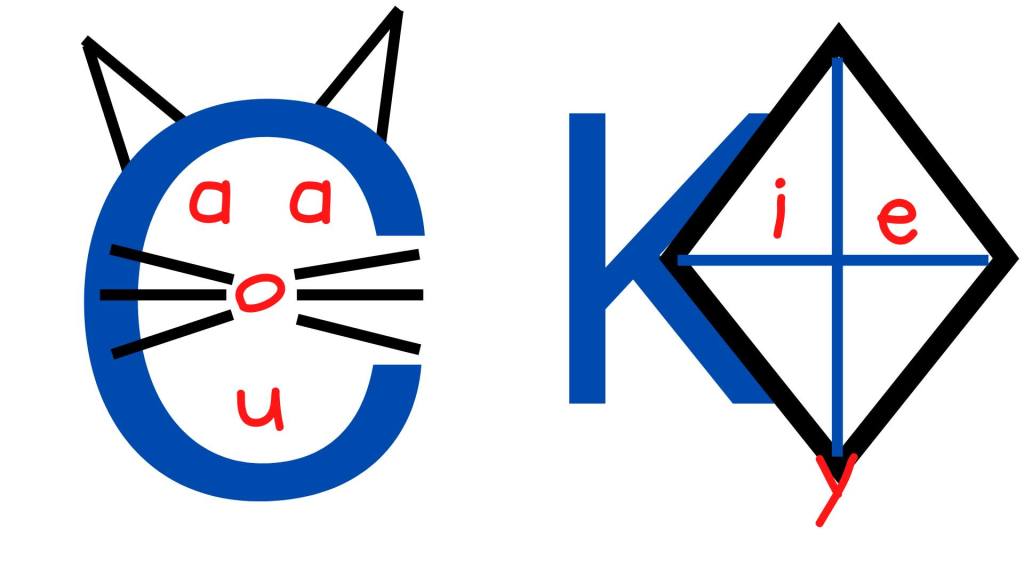
The letter ‘c’ is the first choice at the beginning of a word for the /k/ sound e.g. cat, crab, can. However, if letter after the /k/ sound is ‘i’, ‘y’ or ‘e’ and then the letter ‘k’ is used e.g. kite, key, Kyle.
Sc or Sk
Similar to the c/k rule, the letters ‘sc’ are the usual way to start a word e.g. scab, scratch, scan; however if the next letter is i, y or e, then the letters ‘sk’ are used e.g. skin, sketch, sky. https://dyslexias.blog/spelling-rules/#Rule1
Rule 4: Open and closed syllables (v/cv tiger and vc/cv rabbit words, plus vc/v camel words)
Open and closed syllables are explained in the reading section with the Nessy video, which I have also attached below. Basically, if a vowel is at the end of a short base word or at the end of a syllable, it is called an ‘open syllable’ and the vowel makes a long, strong sound e.g. hē, sū/per. If there is a consonant after the vowel at the end of the short word or the end of the syllable, then the syllable is ‘closed’ and the vowel makes a short, weak sound e.g. hĕn, sŭp/per.
VC/CV (Rabbit generalisation) rule
VC/CV words should have two consonants to keep the first syllable closed and to make the first vowel a short, weak sound e.g. kid/nap, mag/net, at/tic. When spelling words of two syllables , if the first vowel is a short, weak vowel sound and you can only hear one consonant sound imbetween the vowels, then you need to double the medial consonant e.g.rab/bit, cot/ton, rib/bon, mid/dle, trig/ger, let/ter, kit/ten, car/rot.
To sum up, the double consonant rabbit rule is generally used if a word has:
- Two syllables
- First vowel makes a short, weak sound
- Only one consonant sound between the vowels
For children who need to have a visual to relate to, I draw a picture of a rabbit with two ears. The children are advised that the rabbit is a short, weak creature, which relates to the short, weak vowel in the rabbit word. The rabbit has two ears, which reminds the child that they need to ensure when spelling that the rabbit word needs to have two consonants in the middle.
However, this is more of a generalisation rather than a rule as there are many exceptions, which are split vc/v (also called ‘camel’ words), so the first vowel is still a short weak sound as it is in a closed first syllable. Therefore, it is a good idea for learners to write a separate list of the words that do not follow the Rabbit rule whenever they encounter them, examples of these exceptions are: cab/in, med/al, rob/in, mel/on, lem/on, sev/en and are mentioned below.
V/CV (Tiger generalisation rule)
Rabbit words are vc/cv words, whereas ‘Tiger’ words are v/cv words. They are both two syllable words, but Tiger words have a single consonant in the middle. The first syllable in a tiger word is open ti/ger (there is no consonant enclosing the vowel) so the vowel is making the long, strong sound e.g. su/per, hu/man, pa/per. For children who need a visual, I draw a tiger, but the tiger only has one ear because the other ear was torn off in a fight. The one ear of the tiger represents the one consonant in the v/cv word and the tiger is described as a long, strong animal representing the long, strong vowel sound in ‘tiger’ words.
See the example of words here to show the difference in the vowel sound when the vowel is closed in the first syllable in rabbit words compared to when the vowel is in the open syllable in tiger words:
Rabbit words Tiger Words
supper (sup/per) super (su/per)
dinner (din/ner) diner (di/ner)
latter (lat/ter) later (la/ter)
VC/V Camel words
There are some 2 syllable words which are split vc/v and therefore sound as if they should be a rabbit word with two consonants as the first syllable is closed, but in fact they are spelt with only one consonant. These words are often called ‘camel’ words and need to be learned visually to spell. Examples are lemon, melon, robin, habit, comic, satin. These words can be referred to as ‘camel’ words, as the first choice to read them would be v/cv but if that does not sound right, then you can make a ‘hump’ by jumping over the consonant and splitting the word vc/v and making the first syllable closed.
Rule 5 – Suffixes -ed, -ing and doubling rule
Suffix -ed
The suffix ‘-ed’ is added to the end of regular verbs to turn them into past tense’
The suffix ‘-ed’ can make three different sounds i.e. /id/ as in hunted, /t/ as in helped or /d/ as in played. How does an individual know if the sound /t/ at the end of a word is made by the letters ‘t’ or ‘ed’ and how do they know if the /d/ sound is written ‘d’ or ‘ed’? A learner first needs to ensure they can identify root words (a word which makes sense on its own before adding any prefixes or suffxes). To check if a word is just a root word or a root word with a suffix, the learner must take off the end /t/ or /d/ sound and check if it is still a real word. If it is still a real word, then the /t/ or /d/ sound was the suffix ‘ed’ added on to make the verb past tense, but if the word no longer makes sense when the ending is taken away, then the /t/ or /d/ sound is part of the root word and the letters ‘t’ or ‘d’ need to be used. For example, with the word ‘jumped’, if you took away the /t/ sound you would be left with the base word ‘jump’, so the /t/ sound is actually the suffix written ‘-ed’ to make it into a past tense verb. However, with the word ‘rust’ if you took away the /t/ sound you would be left with ‘rus’ which is not a real word, showing that the /t/ sound is part of the base word and so the ending is written with the letter ‘t’.
This next Nessy video explains when to add ‘ed’ onto a word. Where the video mentions adding the ‘ed’ onto a ‘real’ word, it is referring to the ‘root’ word. It is advisable to add the ‘ed’ onto an alphabetical code poster under the sounds /t/ and /d/ so the learner is reminded if they hear a /t/ or a /d/ at the end of a word, they need to distinguish if the sound is part of the root word and is represented by the letter ‘t’ or ‘d’ or if the sound is a suffix and made by the letters ‘ed’.
Suffix -ing
The suffix -ing can be added to a verb to change it from present tense (I jump/He jumps) to present continuous (I am jumping/He is jumping).
Some base words end with the string of letters ‘ing’ without it being a suffix e.g. spring, sing. To check if the ‘ing’ is part of the base word or a suffix, do the same as explained under the heading ‘Suffix -ed’ above i.e. to check if it is a suffix, take off the ‘ing’ and see if you are left with a base word. If you still have a base word then the ‘ing’ of the word is the added suffix, but if the word no longer makes sense, then the ‘ing’ was part of the actual base word and not a suffix.
Double letters before adding a vowel suffix
When adding a vowel suffix such as -ed or -ing to a one syllable word, ending with one short, weak vowel followed by one consonant (such as ‘hop’), then the final consonant needs to be doubled before adding the suffix e.g. hop – hopping, bat – batted. The one, short, weak vowel needs an extra ‘protector’ to keep its short, weak sound and if you forget to add the extra protector consonant, the vowel will turn into a long, stong sound e.g. hoping. Exceptions to this rule are if the word ends with the letter ‘x’ or ‘w’ then the consonant is not doubled, so box – boxed and sew – sewing.
Rule 6 – tch or ch
It is important for learners to know which letters are vowels from an early stage and also be able to identify if a vowel sound in a word is short and weak or long and strong because this is what a lot of spelling rules are based on.
The tch/ch rule is similar to the ‘ck/k’ rule and the ‘Flossy’ rule. If a word ends with the /ch/ sound and is immediately preceded by a short weak vowel, then the protector ‘tch’ is needed at the end of the word e.g. hutch, fetch, latch. However, if the word ends with a /ch/ sound but the vowel has another letter next to it before the /ch/ sound, either a second vowel or a consonant after it, then it is already ‘protected’ and so only the letters ‘ch’ are needed e.g. bench, beach, lurch, search. Just be aware that there are exceptions to this rule including such, much, rich and which.
There are a few free spelling games to practise the tch/ch rule on Spellzone at:
https://www.spellzone.com/word_lists/games-108.htm
Rule 7 – Suffix -es
The usual way to make a word into a plural is to add ‘s’ e.g. dog/dogs, truck/trucks. However, if the noun or the verb end with a ch, sh, s, x, or z, then instead of just the letter ‘s’, the letters ‘es’ are added to make pronouncing the word easier e.g. bunch/bunches, brush/brushes, boss/bosses, box/boxes.
Similarly, the usual way to make a verb into third person singular is by adding ‘s’ e.g. I say/he says, I look/she looks. However, when the verb ends with ch, sh, s, ss, x, or z then ‘es’ is added for the third person e.g. I wish/he wishes, You miss/she misses, I reach/he reaches, I buzz/it buzzes.
BBC Bitesize include this rule in a unit with a short interactive quiz to ensure good understanding of singular and plural and a to add the suffix ‘s’ and ‘es’ which can be accessed by searching BBC Bitesize Adding -s and -es’ or through the link: https://www.bbc.co.uk/bitesize/articles/z3dw4xs
Rule 8 – dge or ge
Words in the English language do not end with the letter ‘j’. Therefore, when words (or syllables) end with the /j/ phoneme, it is written ‘ge’ or ‘dge’. If you hear the /j/ sound at the end of a syllable AND it is immediately preceded by a single, short, weak vowel, the protector ‘dge’ is used e.g. badge, edge, dodge, fudge, but in all other cases the ‘ge’ is used e.g. age, huge, bulge.
Rule 9 – Change ‘y’ to ‘i’ and add ‘es’
The basic rule to make a noun plural or to form a third person verb for any word that ends in a consonant plus ‘y’ is change the ‘y’ to ‘i’ and add ‘es’. For example, the plural of ‘baby’ is ‘babies’ and the verb ‘cry’ changes to ‘cries’. Words which end with a vowel plus ‘y’ do not change (as the ‘y’ is part of a vowel digraph so the ‘y’ cannot be omitted) and therefore the ‘s’ is just added onto the word e.g. play/plays, toy/toys.
Rule 10 – ou or ow
The usual ‘best bet’ is to use ‘ow’ at the end of a word and ‘ou’ in the middle of a word. However, there are exceptions i.e. if the word ends with n, l, er or el then the letters ‘ow’ are used in the middle of the word. The phrase that is used to remind pupils of the exceptions is ‘The brown owl has a flower on his towel’ so they can identify if a word rhymes with brown, owl, towel or flower to use the ‘ow’ in the middle of a word instead of the usual ‘ou’.
Rule 11 – ending -se
Several words end with the letters ‘-se’ with the ‘e’ not seeming to have a purpose in the word. Words with single ‘s’ at the end are usually plurals with the ‘s’ being the suffix to make it plural. Therefore, if the word ‘mouse’ was spelt as mous, then it might be assumed that we were talking about the plural of a word ‘mou’. To avoid this confusion and to spell the word correctly, learners need to remember to place the ‘e’ on the end of words such as house, mouse, horse, course, verse, else etc.
Rule 12 – ending -ve
The letter ‘e’ is added onto words so they don’t end with a ‘v’ e.g. have, shelve, carve etc. I like the Nessy video which gives a humorous explanation why the ‘v’ cannot end the word.
Rule 13 – al, le or el
How do we know when to use ‘al’, ‘le’ or ‘el’ at the end of a word when they all sound the same? As a general rule, you use ‘al’ if you are adding a suffix onto a root word (e.g. magic – magical). Then, the most common ending is ‘le’ and I find this is usually used if the letter before it has a tall stick or tail e.g. little, candle, jingle, tickle. Finally, the letters ‘el’ tend to be used after a small, compact letter such as ‘m’, ‘n’, ‘r,’ ‘v’ and ‘w’ e.g. camel, tunnel, barrel, shovel, trowel. The Nessy video below highlights this last generalisation.
When words end with ‘le’ then they have a consonant before the ‘le’ to make up the syllable. Therefore we see cā/ble, mĭd/dle, tī/tle, gĭg/gle.
 Help your child learn to read, write and spell