
Last week, I was asked if I could explain more about teaching using reading and spelling cards as these are an important part of a dyslexic reading and spelling programme, but can actually be used for all children. Reading and spelling cards have proven to be effective to help all learners read and spell, because the multisensory technique helps individuals to retain what they have learned by making a memorable connection of the grapheme to the phoneme. In fact, most commerical phonic programmes have now realised the benefit of this multisensory teaching and so incorporate reading cards with the grapheme written on the front of the card and a picture on the back of the card relating to the phoneme. It is important that multisensory learning is used to strengthen the neural pathways to the brain to enable more children to reach their full potential.
Below are some youtube videos from Codebrakers explaining how to make individual reading cards as part of a reading programme However, if these cards are being used 1:1 it is important that you check if the child’s school is using a commercial phonics programme which uses images, so that the pictures drawn on the cards correspond with any preprinted grapheme/picture cards the child may be exposed to in school on a daily basis. It could be confusing for a child to try and learn a certain image in relation to a grapheme in a phonics programme in class and then to have to learn another one in an individual programme. The benefit of a learner having their own set of reading cards, where they draw their own picture means that they are holding the cards themselves and therefore adding to the multisensory learning.
The spelling cards are for the adult to hold and then ask the child which grapheme would best represent the phoneme in the beginning, middle or end of a word and they work alongside the reading cards. For example, a learner could have a reading card for ‘ed’ which would have three different pictures and phonemes on the reverse to represent the three different sounds the ‘ed’ can make: /id/, /t/ and /d/. My learners use Nessy to practise reading and spelling on the computer, so we link the pictures on the back of the reading card to the Nessy pictures of ‘hunted’ for /id/, hopped for /t/ and played for /d/. Then three separate spelling cards would be introduced to the learner for the sounds /id/, /t/ and /d/ with all the alternative graphemes that could be used.
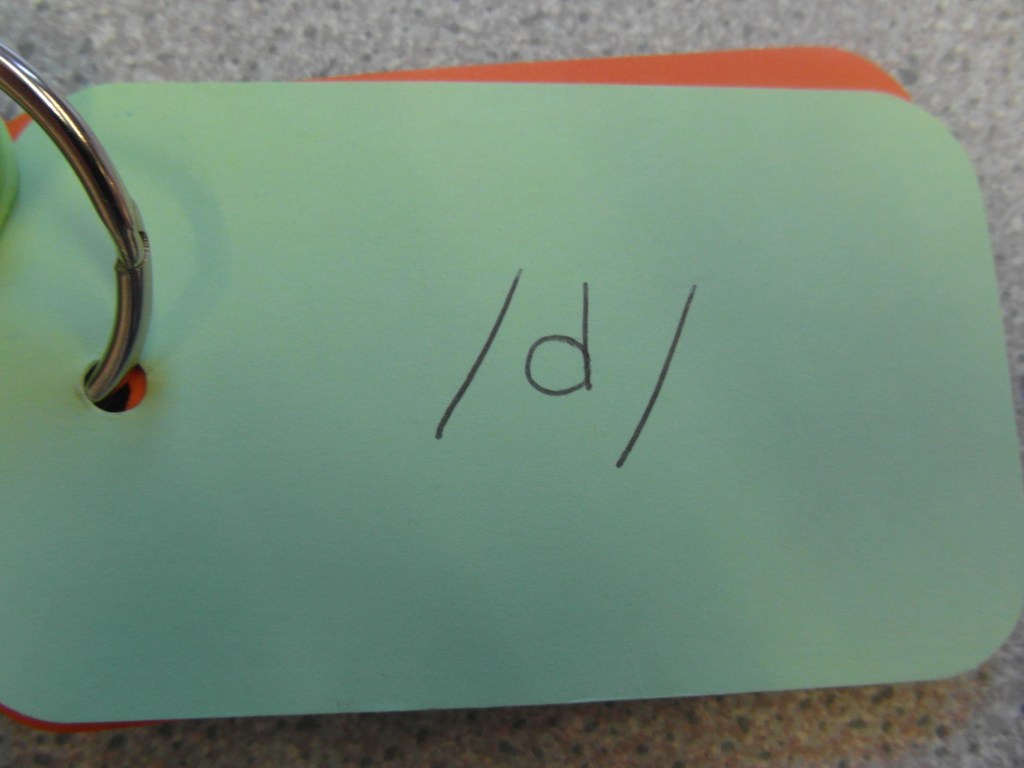
Below is an example of a spelling card for the /d/ phoneme where the spelling of ‘ed’ has been added as a possible alternative for the sound /d/ at the end of a word e.g. played (the ‘ed’ is in fact a suffix and so the learner needs to learn if the /d/ at the end is part of the root (base) word it is written with the ‘d’ , but if it the suffix making that sound, it is written ‘ed’. Both sides of the card are actually green, but somehow the colour seems to be distorted on these photos!
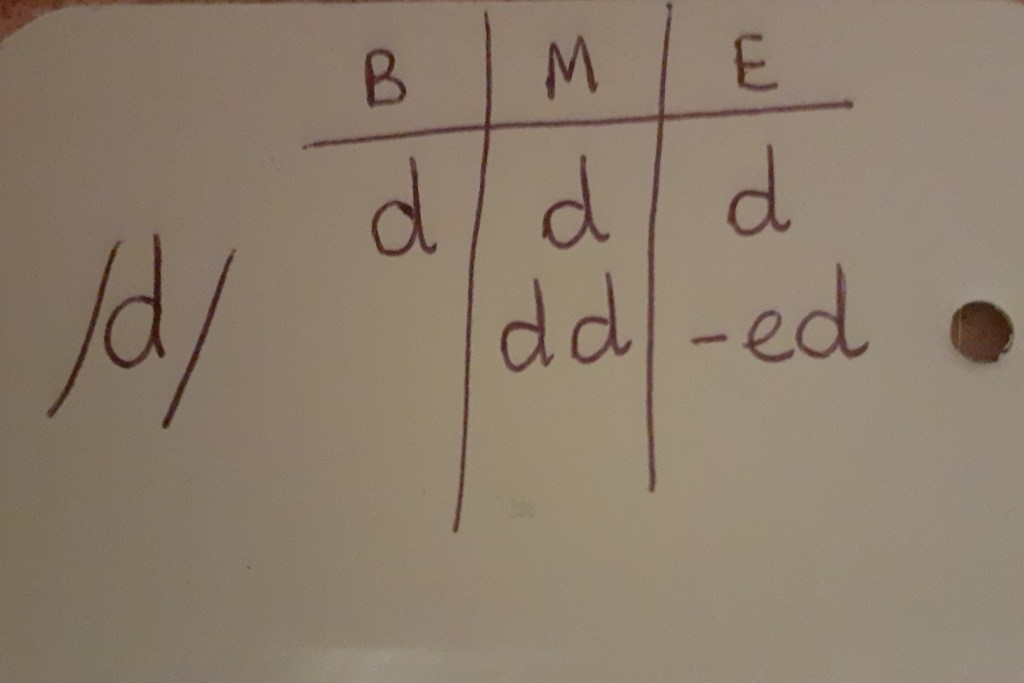
For the spelling card routine, the adult says the phoneme, which the learner repeats and then the learner also says the name of the letter they are writing e.g. they say /d/ – ‘d’ at the beginning and write the letter ‘d’ under the heading ‘B’ as that is how the phoneme is represented at the beginning of a word. Then they say /d/ – ‘d’ in the middle and ‘dd’ in the middle, writing these under the ‘M’ for middle . (A lesson would have been taught advising when the 2 syllable word is a vc/cv word and therefore needing the ‘dd’ combination – see the Spelling Rules page on this site under Rule 4. ) Then finally the student says /d/ – ‘d’ at the end and /d/ ‘ed’ at the end whilst writing the graphemes under the letter ‘E’ for the end of the word. The learner’s BME sheet (a blank copy available below to download) should look identical to the spelling card the adult is holding. I like to then show the spelling card to the student, as they enjoy checking themselves if they were correct. The multisensory technique of saying the phoneme, saying the names of the letters being used and writing them down helps the learner to associate the phoneme with the graphemes and writing them in the correct place they appear in a word will help them to make the right spelling choices in words.
Ensure a student does not ask how to spell a whole word when writing, but they know only to ask for the part of the word they are unsure of, as there will be at least some of the word they can work out to spell themselves. Then, if they ask for help with the part of the word they are struggling with, they need to demonstrate that they are aware what the alternatives could be. A typical question from a student should be “In the word snake, is the /ā/ made by the digraph ‘a’ ‘i’ (saying the names of the letters) or split ‘a-e’?” (again naming the letters) as those would be the most usual alternatives for the /ā/ phoneme in the middle of a word. The student should not be asking if the phoneme is written with the letter ‘a’ in the middle of a one syllable word, as this grapheme is usually only used at the end of a syllable. Similarly for the middle phoneme they should not ask if it is represented by the letters ‘a’ ‘y’ as this digraph is usually only used at the end of a word. Knowing where the graphemes typically represent the sounds in words makes it easier for a child to understand how to spell a word correctly.
I hope today’s blog helps those who wanted some clarification of the reading and spelling cards used in a dyslexic programme and hopefully others find it informative too.
Have a good week everyone. PJ 🙂
 Help your child learn to read, write and spell