20.5.22 Graphemes, Phonemes, Self Esteem and Training Sessions

Photo by Pixabay on Pexels.com

Phonemes and Graphemes Do you know the difference?

I know I specialise in dyslexia, but what is helpful for the dyslexic learner is beneficial to ALL learners. A lot of the explicit teaching used in dyslexic programmes is needed in everyday reading and spelling programmes. There are, however, a lot of misunderstandings amongst children and adults about some of the phonological terms, including how to differentiate between graphemes and phonemes. Many individuals will mistakenly say a phoneme when they are actually referring to the letter rather than the sound and so when digraphs and alternative phonemes for a grapheme are being used this can cause confusion for the student. I have explained these terms on the ‘Alphabet’ page on this site, but Natasha ‘The Phonics Queen’ makes this really clear on her new video, which has been released this week on her youtube channel. Please take a look…..

Phonics Queen youtube channel

Self Esteem

An individual’s level of achievement and behaviour is influenced by how they feel about themselves. Learners with learning differences are more likely to have a lower self esteem, especially if they encounter many difficulties. PATOSS (Professional Association of Teachers of Students with Specific Learning Difficulties) is offering a free webinar entitled ‘Reflections on Enhancing Your Students’ Self-Esteem’ by Denis Lawrence. This on demand webinar is available free of charge to anyone, not just PATOSS members, but is especially useful for educators as it explains how the teacher can have a profound positive impact on their learner. The accompanying resources include a copy of a dyslexic student’s extended essay for Psychology entitled โ€œWhat factors are important to ensure that students with dyslexia have a positive learning experienceโ€. At the time of writing this essay the student was a 17-year-old from Australia, studying in Singapore. Today, he is a teacher in Australia. The essay expresses a dyslexic young personโ€™s perspective with regards to the research. This is a brilliant piece of work which makes really interesting reading. It discusses how much influence parents, educators and peers have on a learner’s self esteem. To access this free webinar and the accompanying resources go to https://www.patoss-dyslexia.org/OnDemand/ondemand-reflections-on-enhancing-your-students-self-esteem-by-denis-lawrence/12202?OccId=17133.

SEN TRAINING SESSIONS

SEND STATION ARE OFFERING THE FOLLOWING TRAINING FOR THE WEEK AHEAD – There are 8 sessions to choose from!!!!!

Monday 23rd

๐ŸŸ ADHD โ€“ an introduction- 7pm

Tuesday 24th

๐ŸŸฃIndependent Learning โ€“ 9.30am

๐Ÿ”ตAlphabet Arc- supporting phonics โ€“ 7pm

๐Ÿ”ตDyslexia Awareness – 7pm

Wednesday 25th

Autism and Play โ€“ 9.30am

๐ŸŸฃGlobal Developmental Delay โ€“ an introduction โ€“ 7pm

Thursday 26th

๐ŸŸขAutism and Visuals – 9.30am

Message from SEND STATION: JOIN US and share with others tooโ€ฆ๐Ÿ™

โ€ฆword of mouth and recommendation helps us to keep our price per delegate to a minimum. ๐Ÿ‘๐Ÿ‘

All sessions this week are:

๐Ÿ‘Œ1.5 hours in length

๐Ÿ‘Œled by professionals who are knowledgeable and experienced

๐Ÿ‘Œpacked with practical ideas you can implement easily

๐Ÿ‘Œlow in price – between ยฃ9.50 and ยฃ10.50 per delegate including booking fee

๐Ÿ‘Œaccompanied by a handout and certificate of attendance and additional resources (where specified).

๐Ÿ‘ŒPopular! High quality! And great value!

Follow this link to find out more and to book your place.

https://www.eventbrite.co.uk/o/send-station-32548686003

Or go to www.sendstation.co.uk

Just to say have a good week everyone! PJ ๐Ÿ™‚

You can please some of the people all of the time,

You can please all of the people some of the time,

But you can’t please all of the people all of the time!

Photo by Mayu on Pexels.com

Mental Health Awareness Week 9.5.22

Photo by Vincent Gerbouin on Pexels.com

I think most of us have days when we don’t feel we are good enough or cannot get things right. If we have other difficulties or problems, then these feelings can multiply. Low self esteem is especially common in those who have specific learning differences and these individuals and their familes can often feel very isolated. This week is Mental Health Awareness Week and there are many new videos and webinars readily available on the internet, alongside leaflets and websites with lots of really useful information to help those who need some support. The youtube video below from the Mental Health Foundation speaks about loneliness and how people can be surrounded by others, but can still feel very lonely. https://www.mentalhealth.org.uk/

Understanding what our difficulties are and finding support from others to help us with challenges make life easier . Just discussing a problem with someone else can make an individual feel better. I particularly love the next youtube video of a young boy who feels different to others and unhappy that he is dyslexic and how his outlook changes when he has a conversation with his teacher.

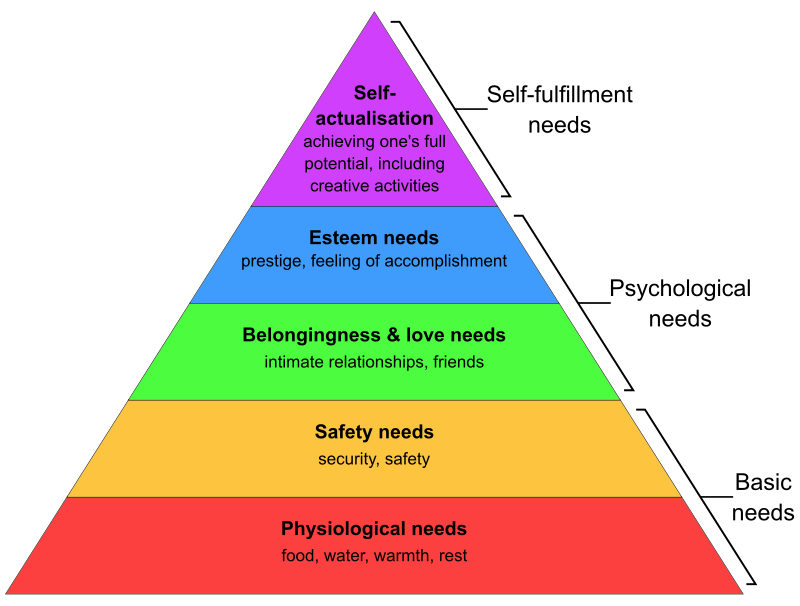
Self esteem and confidence can play such an important part in how successful an individual can be. I am reminded of ‘Maslow’s Hierachy of Needs’ (pictured below), which was created by American psychologist Abraham Maslow in 1943. Maslow suggested that human needs could be put into five levels. It just reiterates that it is difficult for an individual’s full potential to be achieved unless their basic and pyschological needs are met.

Mental health is talked about a lot these days, so we are all more aware of difficulties many individuals encounter and where to find information how to support them. For the younger generation, ‘Young Minds’ is the UKโ€™s leading charity fighting for children and young people’s mental health. They state that they ‘want to see a world where no young person feels alone with their mental health, and all young people get the mental health support they need, when they need it, no matter what’. Visit their webpage on https://www.youngminds.org.uk/ for more information.

For those who want to read more information, Routledge (publishers of professional and academic books) are offering 15% off their mental health books for this month. Go to https://www.routledge.com/

Finally, I leave you with a video from Youtube which always makes me smile, so I hope it does you too. Have a good week. PJ ๐Ÿ™‚

2.5.22 Phonics, Training and Zooms

Photo by Donatello Trisolino on Pexels.com

I hope you all had a lovely Easter. These months are rushing past and I can’t believe it is May already. This week, I wanted to chat about phonics, training (both for the student and the professionals), touch typing and some zoom visits from Puffin authors.

It is useful to explain to individuals when to use ‘ou’ and when to use ‘ow’ in words to represent the /ou/ phoneme. Those of you who have read my recent blogs will recall I have mentioned how it is helpful for students to use the BME (Beginning, Middle and End) sheet for the best bet in spellings. Using the BME, the first choice in the beginning and middle of a word for the phoneme /ou/ is ‘ou’ and the best bet at the end of a word is ‘ow’. However, if a word ends with ‘l’, ‘n’, or ‘er’ then the digraph ‘ow’ is used in the beginning or middle instead. Therefore, we see cloud, pout, spout, but power, owl, trowel and clown. The phrase I use for the children is ‘Theย brownย owlย has aย towelย with aย flowerโ€˜ย with an picture to help them to remember this phrase and if the word rhymes with any of the words in bold, then they use the ‘ow’ instead of the ‘ou’. As usual, there are a few exceptions including the word ‘crowd’, but hopefully this information helps to make the correct spelling choice.

How do we know when to use ‘al’, ‘le’ or ‘el’ at the end of a word when they all sound the same? As a general rule,  you use ‘al’ if you are adding a suffix onto a root word (e.g. magic โ€“ magical). Then, the most common ending is ‘le’ and I find this is usually used if the letter before it has a tall stick or tail e.g. little, candle, jingle, tickle. Finally, the letters ‘el’ tend to be used after a small, compact letter such as ‘m’, ‘n’, ‘r,’ ‘v’ and ‘w’ e.g. camel, tunnel, barrel, shovel, trowel. The Nessy video below highlights this last generalisation.

For those KS2 children who still find handwriting difficult and would benefit from using a computer, a touch typing programme is recommended, so they can learn to type at speed. There are various programmes which will help learners, including Nessy Fingers from ยฃ30 p.a. (more details on https://www.nessy.com/en-gb/product/nessy-fingers-home), the free BBC Dancemat for KS2 students on https://www.bbc.co.uk/bitesize/topics/zf2f9j6/articles/z3c6tfr or Typing Club on https://www.typingclub.com/sportal/program-3.game. If, however, students would like an online class, then see below for details of DITTAS Dyslexia Services on https://www.dyslexiaservices.net/group-tuition

PUFFIN AUTHORS ZOOMING INTO CLASSROOMS

On Friday mornings, authors and illustrators from Puffin books will again be beaming straight into classrooms across the country via Zoom. More details can be found on http://www.puffinschools.co.uk/VirtualVisits. Each FREE 45-minute webinar session will include a presentation giving your pupils a behind-the-scenes look at their books, characters, and creative process before setting an exciting activity for the class. Before the event, you can download their pre-event pack with everything needed for the Visits, and you can also check out the free chapter samples for each book in the event series. Below are details of the next author to visit.

DITTAS DYSLEXIA SERVICES

UK based company DITTAS Dyslexia Services offer assessments, tuition and support for students,  parents and professionals. Find out more about their recommended services, information and training on the website https://www.dyslexiaservices.net/dyslexia-tuiton. Their training and individual tuition can be completed online so suitable for most individuals.

THE ‘PHONICS QUEEN’ TRAINING

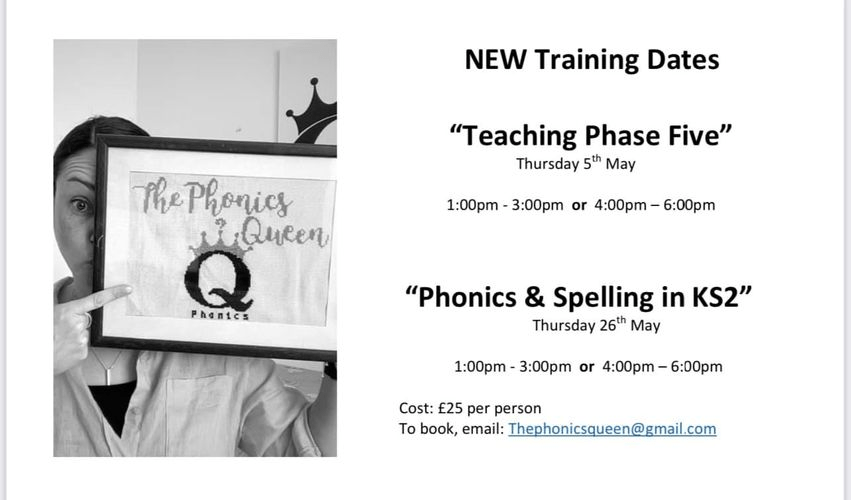
Natasha Tuite, the Phonics Queen (follow her on the facebook group ‘Phonics Queen’) is offering some new training dates for phonics and spelling. Details below:

Have a good week. PJ ๐Ÿ™‚

Photo by Jocelyn Erskine-Kellie on Pexels.com

Kindness costs nothing, but means everything…..

14.4.22 Happy Easter!

Photo by George Dolgikh @ Giftpundits.com on Pexels.com

Just a quick update this week regarding ‘Dyslexia Thinking’, an Easter offer on Nessy programes and details of some SEN training.

If you are dyslexic and have a Linkedin profile, you can now add ‘Dyslexic Thinking’ as one of your skills. In fact, the phrase ‘Dyslexic Thinking’ is now going to be added to Dictionary.com as an official term, due to a campaign by ‘Made By Dyslexia’ .

What is ‘Dyslexic Thinking’? Well, dyslexic individuals can solve problems through their ability of thinking ‘outside the box’. They are often very artistic, have good imaginative skills and can see the ‘big picture’ in order to focus on important elements. Good spatial awareness means the dyslexic brain can usually manipulate 3d images and recognise complex patterns by retaining visual images. Knowing the strengths of those with dyslexia can help understand how individuals learn best and teaching can be adjusted to build on these strengths.

Several top entrepeneurs, including Richard Branson, use their dyslexic thinking skills to their advantage. Their creativity and strategic thinking combined with excellent verbal communication and problem-solving skills are what contribute to make them successful in the business world.

Easter sale on Nessy products

Hop on over to Nessy for a 20% off sale on Home Learning products from 11th -22nd April https://www.nessy.com/shop/home-products, and use the code NESSYEGGS at checkout. ๐Ÿฃ

SEND STATION SESSIONS

The popular and highly recommended Send Station http://www.sendstation.co.uk delivers the following affordable SEN sessions over the coming weeks:

APRIL

Monday 18th

Autism โ€“ Pathological Demand Avoidance – 7pm

Tuesday 19th

Graphic Facilitation- using dual coding -7pm

Wednesday 20th

Reciprocal Reading โ€“ developing comprehension โ€“ 9.30am

Thursday 21st

Autism for Beginners -7pm

Monday 25th

Independent Learning โ€“ 7pm

Tuesday 26th

Autism and Musical Communication โ€“ 9.30am

ADHD โ€“ an introduction -1.30pm

Supporting Literacy โ€“ 7pm

Wednesday 27th

Precision Teaching for LSAs โ€“ 9.30am

Precision Teaching for LSAs โ€“ 1.30pm

Thursday 28th

Global Developmental Delay โ€“ an introduction – 9.30am

Dyslexia Awareness – 9.30am

Auditory Processing Disorder โ€“ 7pm

MAY

Tuesday 3rd

Autism and Emotional Regulation โ€“ 9.30am

Speech and Language Difficulties โ€“ and introduction โ€“ 1.30pm

Autism and Anxiety -7pm

Wednesday 4th

Alphabet Arc- Supporting Phonics – 9.30am

Thursday 5th

SENDStational Spelling – 7pm

Monday 9th

Precision Teaching โ€“ sight words to fluency โ€“ 7pm

Tuesday 10th

The Engagement Curriculum Personalised Planning โ€“ 9.30am

Developmental Language Disorder โ€“ 7pm

Wednesday 11th

Autism and Girls – 9.30am (Nic’s zoom)

Speech and Language Difficulties- an introduction โ€“ 9.30am

Autism and Emotional Regulation โ€“ 7pm

Thursday 12th

Memory Matters โ€“ 9.30am

Autism and Girls 2 Practical Strategiesโ€“ 7pm

Monday 16th

Speech Sounds โ€“ 7pm

Tuesday 17th

Autism and PDA โ€“ 9.30am

Graphic Facilitation โ€“ using dual coding โ€“ 9.30am

Developmental Language Disorder โ€“ 7pm

Wednesday 18th

Auditory Processing Disorder โ€“ 10am

Reciprocal Reading โ€“ developing comprehension โ€“ 7pm

Thursday 19th

Autism and Anxiety โ€“ 9.30am

Autism and Girls โ€“ 7pm

Monday 23rd

ADHD โ€“ an introduction- 7pm

Tuesday 24th

Independent Learning โ€“ 9.30am

Alphabet Arc- supporting phonics โ€“ 7pm

Dyslexia Awareness – 7pm

Wednesday 25th

Autism and Play โ€“ 9.30am

Global Developmental Delay โ€“ an introduction โ€“ 7pm

Thursday 26th

Autism and Visuals – 9.30am

Monday 30th

Memory Matters- 7pm

Tuesday 31st

Autism for Beginners 9.30am (Nic’s zoom)

SENDStational Spelling โ€“ 9.30am

Autism and Emotional Regulation -7pm

GO TO WWW.SENDSATION.CO.UK for more details and bookings.

HAPPY EASTER EVERYONE! PJ ๐Ÿ™‚

Photo by George Dolgikh @ Giftpundits.com on Pexels.com

6.4.22 Reading and spelling strategies

Syllables

Photo by Mariana Kurnyk on Pexels.com

For reading and writing longer words, chunking into syllables has always been the definite way to go! (Ok, I know I may have mentioned this quite a few times before, but it is so essential!) An awareness and knowledge of vowels is also important, as each time we count the syllables in a word, we are actually counting the vowel sounds. For those who have been following this blog and site for a while, you will know that that when we say a vowel sound, our mouths are open and there is nothing obstructing the flow of air (see information on vowels on the ‘Alphabet’ page). It is important that children quickly learn how to identify if a longer word has a closed syllable e.g. vc/cv or an open syllable e.g. v/cv in order to pronounce the vowel sound correctly (short, weak vowel sound in closed syllable or long, strong vowel sound in open syllable). They also need to learn how to spell these words using the closed/open syllable rule e.g. sup/per or su/per. Read more on the ‘Reading’ page under the sub heading ‘syllables’ and also on the page ‘Spelling Rules’, Rule 4. A good knowledge of syllable division and understanding of vowels can really help a learner quickly develop their reading and spelling skills.

I wanted to share these videos by Carla Siravo and Mike Archangelo as they have made quite a few phonics videos, which always make me smile. These videos reinforce the open and closed syllable rules in a fun way and might help some children to remember the rules! Enjoy!

I particularly like this video they have made, reminding learners not to guess words, but to use strategies they have been taught!

Free Phonics Apps from Nessy

Nessy is giving away three phonics apps free for Easter! For one week only until 11th April! Go to Nessy.com to find them.

Help for Reading and Spelling

Just a quick blog this week, as I am recovering from Covid and still not feeling too great! I hope the videos made you smile and you are all recovering quickly from any illnesses. We all look forward to brighter days ahead – it is nearly Easter everyone! Take care. PJ ๐Ÿ™‚

Photo by Jos van Ouwerkerk on Pexels.com

31.3.22 Phonics Queen

The Phonics Queen’s latest video on Youtube has been released today and she is happy for it to be shown far and wide! This video, which is entitled ‘Phonics is NOT just an EYs and KS1 thing’ , explains that phonics does not stop being taught after KS1. I share Natasha’s passion of phonics (as you may have already noticed from this site!) and we seem to also share the same points of view and ideas how to develop these skills. Natasha (The Phonics Queen) just articulates it all so much better than I ever could! Have a look at this video and find more useful videos on her Youtube Channel.

The Phonics Queen Youtube Channel

28.3.22 Reading and spelling cards

Photo by Suzy Hazelwood on Pexels.com

Last week, I was asked if I could explain more about teaching using reading and spelling cards as these are an important part of a dyslexic reading and spelling programme, but can actually be used for all children. Reading and spelling cards have proven to be effective to help all learners read and spell, because the multisensory technique helps individuals to retain what they have learned by making a memorable connection of the grapheme to the phoneme. In fact, most commerical phonic programmes have now realised the benefit of this multisensory teaching and so incorporate reading cards with the grapheme written on the front of the card and a picture on the back of the card relating to the phoneme. It is important that multisensory learning is used to strengthen the neural pathways to the brain to enable more children to reach their full potential.

Below are some youtube videos from Codebrakers explaining how to make individual reading cards as part of a reading programme However, if these cards are being used 1:1 it is important that you check if the child’s school is using a commercial phonics programme which uses images, so that the pictures drawn on the cards correspond with any preprinted grapheme/picture cards the child may be exposed to in school on a daily basis. It could be confusing for a child to try and learn a certain image in relation to a grapheme in a phonics programme in class and then to have to learn another one in an individual programme. The benefit of a learner having their own set of reading cards, where they draw their own picture means that they are holding the cards themselves and therefore adding to the multisensory learning.

Codebreakers youtube

The spelling cards are for the adult to hold and then ask the child which grapheme would best represent the phoneme in the beginning, middle or end of a word and they work alongside the reading cards. For example, a learner could have a reading card for ‘ed’ which would have three different pictures and phonemes on the reverse to represent the three different sounds the ‘ed’ can make: /id/, /t/ and /d/. My learners use Nessy to practise reading and spelling on the computer, so we link the pictures on the back of the reading card to the Nessy pictures of ‘hunted’ for /id/, hopped for /t/ and played for /d/. Then three separate spelling cards would be introduced to the learner for the sounds /id/, /t/ and /d/ with all the alternative graphemes that could be used.

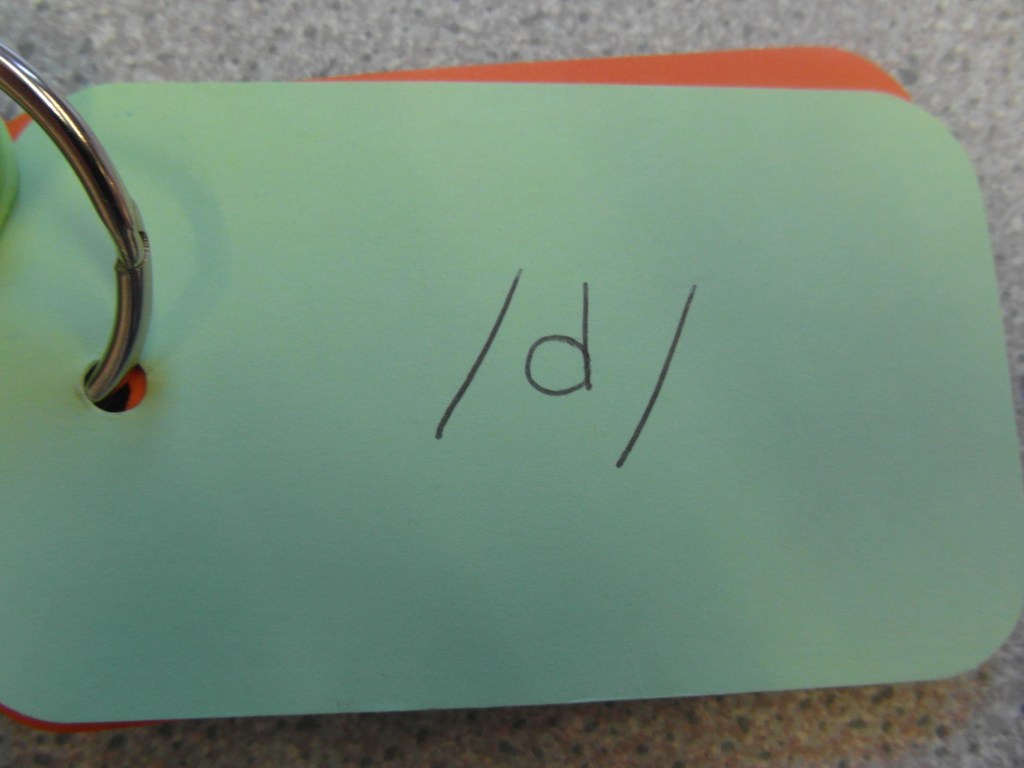
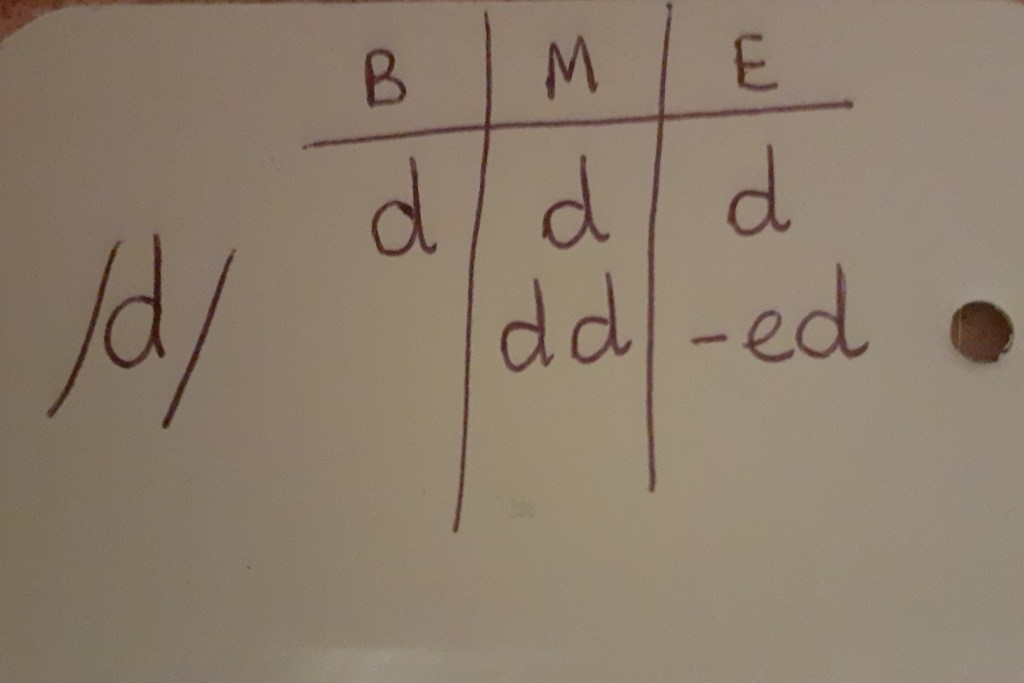
Below is an example of a spelling card for the /d/ phoneme where the spelling of ‘ed’ has been added as a possible alternative for the sound /d/ at the end of a word e.g. played (the ‘ed’ is in fact a suffix and so the learner needs to learn if the /d/ at the end is part of the root (base) word it is written with the ‘d’ , but if it the suffix making that sound, it is written ‘ed’. Both sides of the card are actually green, but somehow the colour seems to be distorted on these photos!

For the spelling card routine, the adult says the phoneme, which the learner repeats and then the learner also says the name of the letter they are writing e.g. they say /d/ – ‘d’ at the beginning and write the letter ‘d’ under the heading ‘B’ as that is how the phoneme is represented at the beginning of a word. Then they say /d/ – ‘d’ in the middle and ‘dd’ in the middle, writing these under the ‘M’ for middle . (A lesson would have been taught advising when the 2 syllable word is a vc/cv word and therefore needing the ‘dd’ combination – see the Spelling Rules page on this site under Rule 4. ) Then finally the student says /d/ – ‘d’ at the end and /d/ ‘ed’ at the end whilst writing the graphemes under the letter ‘E’ for the end of the word. The learner’s BME sheet (a blank copy available below to download) should look identical to the spelling card the adult is holding. I like to then show the spelling card to the student, as they enjoy checking themselves if they were correct. The multisensory technique of saying the phoneme, saying the names of the letters being used and writing them down helps the learner to associate the phoneme with the graphemes and writing them in the correct place they appear in a word will help them to make the right spelling choices in words.

Ensure a student does not ask how to spell a whole word when writing, but they know only to ask for the part of the word they are unsure of, as there will be at least some of the word they can work out to spell themselves. Then, if they ask for help with the part of the word they are struggling with, they need to demonstrate that they are aware what the alternatives could be. A typical question from a student should be “In the word snake, is the /ฤ/ made by the digraph ‘a’ ‘i’ (saying the names of the letters) or split ‘a-e’?” (again naming the letters) as those would be the most usual alternatives for the /ฤ/ phoneme in the middle of a word. The student should not be asking if the phoneme is written with the letter ‘a’ in the middle of a one syllable word, as this grapheme is usually only used at the end of a syllable. Similarly for the middle phoneme they should not ask if it is represented by the letters ‘a’ ‘y’ as this digraph is usually only used at the end of a word. Knowing where the graphemes typically represent the sounds in words makes it easier for a child to understand how to spell a word correctly.

I hope today’s blog helps those who wanted some clarification of the reading and spelling cards used in a dyslexic programme and hopefully others find it informative too.

Have a good week everyone. PJ ๐Ÿ™‚

23.3.22 Dysgraphia

Photo by picjumbo.com on Pexels.com

What is Dysgraphia?

This week, I wanted to write a little about dysgraphia, which is characterized by writing difficulties and can occur on its own or alongside another learning difficulty such as dyslexia.

So what does dygraphia mean? Dysgraphia is a Greek word. The prefix dys indicates that there is a difficulty and graph refers to producing letter forms by hand. Therefore, dysgraphia is the difficulty of letter writing by hand, which can affect learning to spell words in writing and the speed of writing text. Children with dysgraphia may have only handwriting difficulties , only spelling difficulties (without reading problems), or both handwriting and spelling difficulties.

  • SIGNS OF DYSGRAPHIA MAY INCLUDE:
  • Difficulty with formation of letters
  • Illegible or inconsistent writing
  • Mix of cursive and print
  • Mix of upper and lower case
  • Inappropriate sizing and spacing of letters
  • Slow or laboured writing
  • Unusual body or hand position when writing
  • Difficulty writing in a straight line
  • Skipping letters in words or omitting words altogether
  • Cramps or pain in the fingers, wrist or palms whilst writing
  • Many children with dysgraphia also have low self esteem relating to their writing difficulty
  • Frustrations, stress and anxiety could manifest in poor academic performance or inappropriate behaviour

Dysgraphia makes writing, spelling and forming words challenging because it affects an individual’s handwriting ability and their fine motor skills. This disorder is usually noticeable as soon as a child starts to write. It can be hard for a student with dysgraphia to understand how lines and curves combine to form letters and therefore they may struggle to copy the formation of a letter in order to display phoneme/grapheme correspondence. The extra effort of concentrating on their writing will make a learner tire very quickly.

Dyslexic Advantage youtube channel

HOW TO HELP THE DYSGRAPHIC LEARNER WITH WRITING

  • Practise gross and fine motor skills regularly
  • Ensure the child is sitting with feet flat on the floor to create stability
  • Remind them to use their non writing hand to stablise the page whilst they write
  • Demonstrate how to hold the pencil correctly (see pinch and flip trick in video below) or give student a pencil grip to use if they find that helpful
  • Consider using a writing slope
  • Limit the amount of writing expected
  • Use visual prompts to help reduce their cognitive load
  • Use a handwriting programme such as Write From The Start (these booklets guide children through the various stages of perceptual and fine motor development)
  • ALTERNATIVES FOR THE DYSGRAPHIC LEARNER INSTEAD OF HANDWRITING
  • Pair dysgraphic learners up with a note-taking buddy.
  • Encourage student to use computer to type up work (learning touch typing will make typing up work quicker and easier)
  • Use speech to text software
  • Create oral assessment opportunities so students can demonstrate their knowledge without having to write
  • Use mindmaps

Free Spelling Practice for Year 5/6 Spelling Frame

Spelling Frame have announced that all year 5/6 spelling lists will be free to use for additional practice until SATS. Go onto http://www.spellingframe.co.uk.

We are now coming towards the end of March and I don’t know about you, but I am looking forward to the lighter evenings after the clocks go forward an hour in the UK this weekend (on Mothering Sunday). FIngers crossed the nice sunny weather continues. I hope everyone manages to have a healthy, happy week. PJ ๐Ÿ™‚

Everyone needs someone to believe in them….

Photo by S Migaj on Pexels.com

Eve

14.3.22 Phonological awareness

Photo by Alexandr Podvalny on Pexels.com

I usually compare the skills of phonological awareness with laying the foundations of a house, because the art of learning to read and write is built on these important listening skills. The introduction to phonological awareness is usually classed as ‘Phase one’ in phonics development and should begin to be taught at nursery/preschool age so that children are ready to begin learning phase 2 phonics (the grapheme/phoneme correspondence) once they start primary school. However, these skills continue to be strengthened whilst learning new phonics skills. Take a look at the page on this site Phonological and Phonemic Awareness for more details.

Phase 2 phonics is learning grapheme/phoneme correspondence and coincides with the start of Reception in primary school when most phonics programmes start, whereas in phase one for phonological awareness, no written letters are used, it is all about the phonological aspect of listening skills. The children should learn to identify the beginning sound of a word, discover how to blend syllables and phonemes to make words. The ‘Phonics Queen’ (her group is on facebook) offers quality Phase one training at regular intervals for Nursery and preschool settings in order to develop children’s listening skills. These can be booked by emailing Natasha (The Phonics Queen) at: thephonicsqueen@gmail.com. Natasha is an experienced reception teacher, tutor and speaker and also shares her knowledge through some videos on her youtube channel.

The Letters and Sounds document Natasha mentions in the following video is no longer published, but still has valid information and contains great phase one activities to support the learner. It is available to download on https://assets.publishing.service.gov.uk/government/uploads/system/uploads/attachment_data/file/190599/Letters_and_Sounds_-_DFES-00281-2007.pdf This document is not to be used as a stand alone phonics programme, although many new validated schemes are based on this Letters and Sounds document. Phase one is not always emphasised in new phonics schemes for schools, as it is expected that children have been exposed to these skills in preschool and nursery or at home, but it is important that they are not overlooked.

Phonics Queen youtube channel

It is important to continue developing the understanding of syllables for accurate reading and spelling. A lot of spelling rules depend on how many syllables are in a word, the sound at the end of a syllable etc.

Nessy Go Hairy phonics youtube channel

For school age children who continue to have difficulty discriminating the phonemes in words, then lots of extra practise manipulating sounds is recommended. I like to use the phonological awareness programme from the book ‘Sound Linkage’ by Peter Hatcher as it sets out all the different skills required for phonological awareness and lots of different activities to help support the learner. Don’t forget if a child is struggling to discriminate sounds, check they have had a recent hearing test.

Have a good week. Be brave, be strong and be kind. PJ ๐Ÿ™‚

Try to be a rainbow in someone else’s cloud.

Photo by Ben Mack on Pexels.com

Dyslexia and Nessy 8.3.22

Photo by THIS IS ZUN on Pexels.com

International Women’s Day

Today is International Women’s Day and on the British Dyslexia Association’s youtube channel, dyslexia amabassador Adelle Tracey shares what this day means to her.

Nessy

I regularly use the fabulous Nessy computer programme when working with students who find reading or spelling tricky and Nessy.com really advocate for dyslexic individuals. The company was founded by Mike Jones and his mother in order to help dyslexic learners like himself. Pat Jones discovered many strategies to help her son Mike learn to read and spell when he was young. Go to my previous blog Talking about Nessy etc to read about their inspiring story.

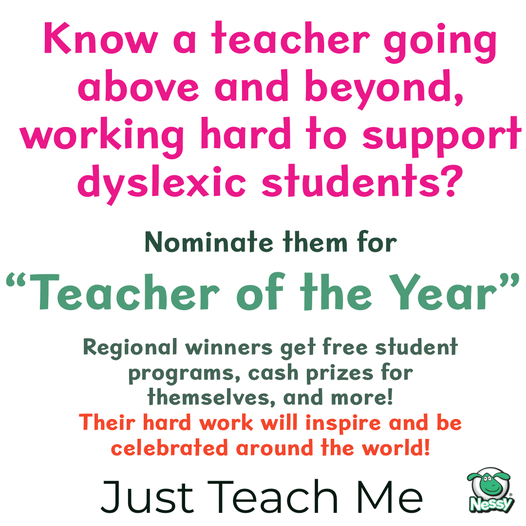
It is really important that educators understand how dyslexic individuals learn best so that these students can reach their full potential. The team of Nessy are awarding prizes to celebrate teachers who are going above and beyond to support neurodiversity. Do you know a Dyslexia aware teacher? A teacher who has gone above and beyond supporting diverse learners? Nominate your teacher by emailing news@nessy.com or sending them a direct message on facebook messenger. Tell Nessy how the teacher is supporting dyslexic students and diverse learners. Finalists and winners win great prizes. Nominate a teacher you know today. Deadline for nominations is the 24th March!

For those educators and parents who want to find out more about dyslexia and how best to support dyslexic individuals, go to the Nessy page https://www.nessy.com/en-gb/dyslexia-explained/how-to-help-dyslexia.

Watch and share this youtube video about Sophie , a nine year old girl who is dyslexic and struggles with reading and spelling. She talks about how she feels about dyslexia and how she finds ways to do things differently.

Many other difficulties may co-occur with dyslexia, including dysgraphia, dyspraxia and dyscalculia. I will try to include more details of these difficulties and strategies that can be used to support individuals in next week’s blog.

Have a good week everyone and try and make some time for yourselves. PJ ๐Ÿ™‚

โ€œYou are never too old to set another goal or dream a new dream.โ€

Les Brown


Photo by Takao Numata on Pexels.com